What does Google Glass do to conversations?

This guest blog is by Brian Lystgaard Due,  University of Copenhagen, who has been researching the fascinating question of what it means to wear a mobile camera while going about one’s everyday business.

Brian Due

Brian Lystgaard Due

The social implications of using Google Glass

When I first heard of Google Glass (GG) I was struck by its design and functionality, and thought to my self: How will these works in social interaction? So I contacted a Danish spectacles foundation (Synoptik Fonden) and applied for extra research funding. I bought a pair of GG in January 2014, google glassand wore them as part of a breaching experiment with my self and my different soundings as research objects. I experienced many interesting possibilities but also vast limitations. So I organized three different social experiments and video recorded them.

Read more ….

Most cited papers in three related journals

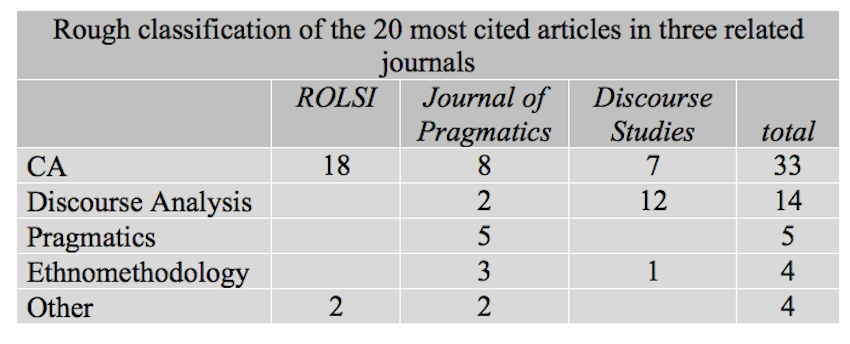
The table below is based on my own (admittedly arguable) categorisation of the articles that appear as the “20 most cited” on the publishers’ webpages for ROLSI, the Journal of Pragmatics and Discourse Studies in March 2015.

Most cited

What I notice is that those of ROLSI‘s articles that are most cited are almost all Conversation Analytic ones, perhaps reflecting the journal’s centre of gravity over the last decade. Discourse articles feature most in Discourse Studies, as might be expected, and the Journal of Pragmatics is by far the most eclectic. Interestingly enough, CA articles also make a good showing in these latter two journals as well as in ROLSI.

The current Editorial Board members

The current Board is composed of distinguished language-in-interaction experts with global reputations. We’re delghted to have representatives from, in alphabetical order, Denmark, Finland, Germany, Japan, Norway, Sweden, Switzerland, the UK and the USA.

Charles Antaki
(Editor) Loughborough University, UK
Robert Arundale University of Alaska, USA
Mary Bucholtz University of California, Santa Barbara, USA Richard Buttny Syracuse University, USA
Donal Carbaugh University of Massachusetts Amherst, USA Steven Clayman University of California, Los Angeles, USA
Elizabeth Couper-Kuhlen University of Helsinki, Finland Galina Bolden Rutgers University, USA
Paul Drew University of York, UK Andrea Golato Texas State University, USA
Anita Fetzer University of Stuttgart, Germany Kristine Fitch University of Iowa, USA
Phillip Glenn Emerson College, USA Charles Goodwin University of California, Los Angeles, USA
Leelo Keevallik Linkoping University, Sweden John Hellermann Portland State University, USA
John Heritage University of California, Los Angeles, USA Irene Koshik University Of Illinois At
Urbana-Champaign, USA
Curtis LeBaron Brigham Young University, USA Douglas Maynard University of Wisconsin-Madison, USA
Lorenza Mondada University of Basel, Switzerland Junko Mori University of Wisconsin-Madison , USA
Aug Nishizaka Chiba University, Tokyo, Japan Gerry Philipsen University of Washington, USA
Anssi Peräkylä Helsinki University, Finland Robert Sanders University at Albany, SUNY, USA
Emanuel Schegloff University of California, Los Angeles, USA Jakob Steensig University of Aarhus, Denmark
Tanya Stivers University of California, Los Angeles, USA Jan Svennevig University of Oslo, Norway
Johanna Ruusuvuori Tampere University, Finand Karen Tracy University of Colorado at Boulder, USA

Five new members of the Editorial Board

We are delighted and honoured to announce five new members of the Editorial Board (as from April 2015).

Each is a distinguished expert in her or his field of language in interaction, and each has already performed sterling service in providing the journal with outstandingly thorough, scholarly and constructive reviews of submissions. Welcome to:

Galina Bolden (Rutgers University, USA) Portraits of Faculty & Staff or SCILS
Andrea Golato (Texas State University, USA) golato
Leelo Keevallik (Linköping University, Sweden) keevallik
Anssi Peräkylä (Helsinki University, Finland) perakyla
Johanna Ruusuvuori (Tampere University, Finland) ruusuvuori

How I wrote a complete bibliography for ROLSI

We’re exceptionally pleased to host a guest blog from Maurice Nevile (University of Southern Denmark), who tracked down and listed every single article published in ROLSI between 1987 and 2014. Here is his account of how he did it.

photo

Did Harvey Sacks ever publish in ROLSI? Which studies examine repair? Do any ROLSI papers investigate interactional phenomena of German? A complete chronological bibliography for ROLSI (from 1987) now makes it easier to search within the journal for particular authors, analytic interests and phenomena, settings and forms of data, languages, or whatever. I initially compiled the bibliography to support a review study on embodiment, and then developed it for wider public use. Every item is listed with full citation details, and web address for access via the publisher’s website.

Read more….

Conversation Analysis in India

We are delighted to welcome Dipti Kulkarni, Assistant Professor at MICA, Ahmedabad (India) who contributes a fascinating blog on CA in India.

I am neither a linguist nor a sociologist by training. I have a Masters in communication studies, which got me interested in interpersonal communication and meaning making. I first stumbled upon CA during my doctoral research. I was trying to figure out if we could develop Gricean kind of maxims for casual conversations (or what Malinowski called “phatic” communion). I had collected internet chats for the purpose, but soon realized that natural conversations are too unwieldy to be dealt with by Gricean theory or speech act theory – which is when conversation analysis really proved useful. So far, I have used CA only to look at textual interactions and have not really confronted the beast of oral conversations! The transcriptions are scary as they are for monolingual English interactions, I cannot imagine the nightmare of dealing with Indian data where speakers constantly switch between multiple languages. Not only that, as my disgruntled colleagues have often complained, neither do we wait for others to finish! So I will be transcribing overlapping speech for about 4-5 speakers at a time!

Read more ….

Which journals cite ROLSI (and vice versa)?

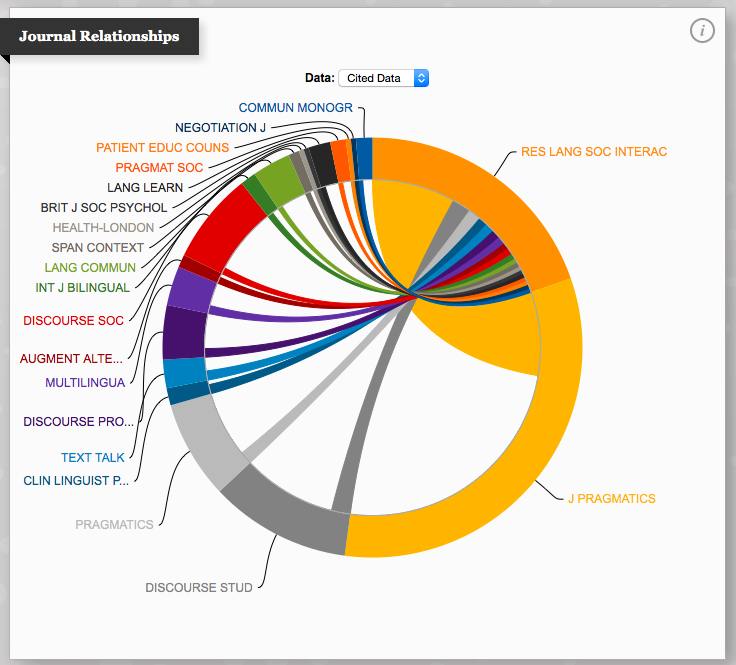
The Thompson-Reuters Web of Knowledge gives a great deal of bibliographic data about journals. I find these two graphical images intriguing: they show where ROLSI is cited (on thetop), and what journals ROLSI cites (at the bottom). Data are from the 2012-2013 period.

You’ll see that there’s a fair amount of self-citation, but that otherwise the biggest partner is the Journal of Pragmatics. What is perhaps surprising, and pleasing, is the number and variety of journals in which ROLSI is cited (lower image) – they range from the Negotiation Journal to the International Journal of Bilingualism. That shows the range of interest that ROLSI articles generate.

rolsicitingrolsicited

ROLSI Journal Impact – historical trend

The figures for the 2013-2014 period will be out soon, so it might be worth looking at the historical trend.

ROLSI started quietly, but built up a decent following, and by the 2010s had reached a pleasing impact rate. It is now over 2, making it the second most cited journal in Communications, and third in Linguistics.

We look forward to what the next, imminent, set of figures will reveal.

rolsiimpact2

Entertaining video clips for teaching (5)

Jenny Mandelbaum offers these videos that she and colleagues use in teaching CA at Rutgers:

Jenny adds that YouTube has a free downloader, called YTD Video Downloader, available at http://download.cnet.com/YTD-Video-Downloader/3000-2071_4-10647340.html

Data sessions around the world

Many groups of language-in-interaction researchers have regular meetings at which they look over a recording and share their analytic insights. These data-sessions can be a very useful and productive way of generating ideas, as well as being enjoyable occasions for like-minded researchers to feel part of a community.

Over the next weeks we shall be drawing up a list of these data sessions, to have a record of them in one place.

If anyone would like to add their group to the list, do please contact us at c.antaki@lboro.ac.uk.