Category Archives: Teaching

Guest Blog: Can you use an AI-generated podcast of a ROLSI article to help teach CA?

No one in higher education will escape the urgent debate about the role of AI in teaching and learning. But what, specifically, does it mean for teaching conversation analysis? Is there anything about the peculiarities of generative AI that could actually be useful? Bogdana Huma, Nthabiseng Shongwe, Borbála Sallai, all from the Vrije Universiteit Amsterdam, take us through an intriguing experiment which tries to answer that question. Along the way, Bogdana links to an intriguing AI-generated podcast of a ROLSI article, which is a fascinating artefact in its own right, and a novel teaching resource.

Bogdana Huma, Vrije Universiteit, Amsterdam

In academia, the availability of generative Artificial Intelligence (genAI) through platforms such as ChatGPT, Claude, or NotebookLM has started to transform how we work, how we teach, how we learn, and even how we think. When we seek information, it is tempting to turn to these platforms, even though we know that their answers can be unreliable. Referred to as “hallucinating”, “falsifying”, or “fabricating”, making up facts is genAI’s well-known Achilles’ heel for which there is no remedy in sight.

In this blog post, we report on how we can turn genAI hallucinations from a problem to a resource in teaching conversation analysis (CA) while also stimulating critical engagement with genAI outputs.

Teaching CA and AI literacy skills with NotebookLM

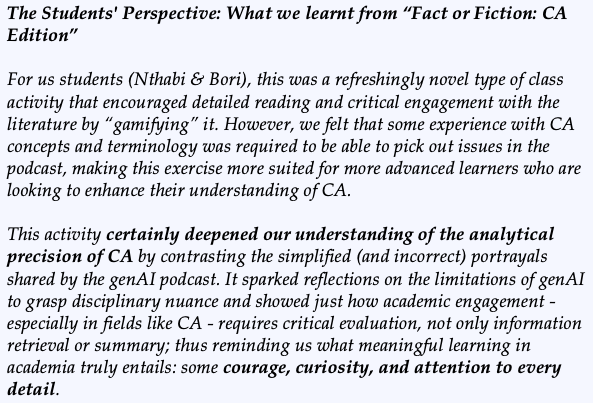
Explaining CA’s unique take on language and social interaction, whether to professionals or university students, can be challenging. Previous ROLSI blogs provide excellent tips for engaging novices, such as using analogies, showing clips from TV shows, or letting learners discover CA principles for themselves. But once convinced of CA’s value, how do we help learners to climb the steep CA learning curve? The educational activity “Fact or Fiction: CA Edition” described below aims to support advanced CA learners to fine-tune their understanding of complex CA principles and ideas. As a bonus, it also supports learners to engage with genAI in a critical and productive way by increasing their awareness of and ability to recognise AI hallucinations.

The Teacher’s Perspective

I designed an activity I called “Fact or Fiction: CA Edition” and asked a group of master’s students, including Nthabi and Bori, to complete it as part of the course Medical and Healthcare Interactions in the Dialogue, Health, and Society master’s track at the Vrije Universiteit Amsterdam.

Their task: Read a paper, then listen to an AI-generated podcast based on it.

The coursework assignment required students to read a CA paper first (Parry & Barnes, 2024), and then listen to an AI-generated podcast supposedly describing it to a wide audience. The students’ task was to answer this question: does CA’s unique approach to language and social interaction come across correctly in the AI-generated podcast?

To no one’s surprise: it doesn’t.

Taking advantage of the AI podcasts’s failings.

Now that I had an interpretation of a CA paper (albeit generated by AI), I could invite the students to do a number of useful things with it. For example, if you’re aiming to stimulate careful reading, students can be asked to identify key ideas that the podcast conveys accurately as well as inaccurately. Alternatively, if you’re aiming to support students to comprehend CA’s unique perspective, then the task can focus on uncovering aspects of CA that are misrepresented. The activity can be completed in class (as seen in Figure 1) or at home, either individually or in small groups. Importantly, always follow up with an in-class discussion in which you can clarify some of the trickier CA concepts or principles to ensure that students have correctly grasped them.
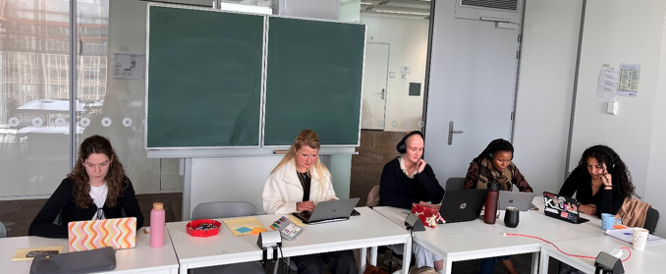
Figure 1 Photo of students completing “Fact or Fiction: CA Edition” in class

Hallucinating CA

How well, in fact, does AI deal with a real CA paper? To exemplify, we’ll draw on the state-of-the-art review article Conversation-Analytic Research on Communication in Healthcare: Growth, Gaps, and Potential from ROLSI’s special issue on healthcare interactions.

The podcast was produced with Google’s genAI-powered platform NotebookLM which generates surprisingly realistic two-speaker audio overviews of user input, such as PDFs of research articles. It really is as easy as uploading the PDF to the site, and pressing a button; a few moments later, a sound file appears which you can download and play. For anyone who has not heard this kind of thing before, you will be struck by the apparent naturalness of the talk – the in-breaths, repair, overlap and general “feel” of real talk. Only the occasional stumble will give it away, and extended listening will start to reveal repetitive patterns and formulas.

Want to hear what it sounds like? You can listen to the whole podcast here (click to play). For a sense of the style of the talk, here’s a brief snippet of transcript.

Podcasts vary in length and coverage, sometimes zooming in on tiny details in the papers and other times bringing in ideas that have little or nothing to do with the content of the article. The podcast about Conversation-Analytic Research on Communication in Healthcare: Growth, Gaps, and Potential has a promising start. The hosts describe CA as a “really cool way of looking at how communication actually works in healthcare setting” because “it’s like you’re listening in on doctor-patient conversations, but with like a super high-powered microscope”.
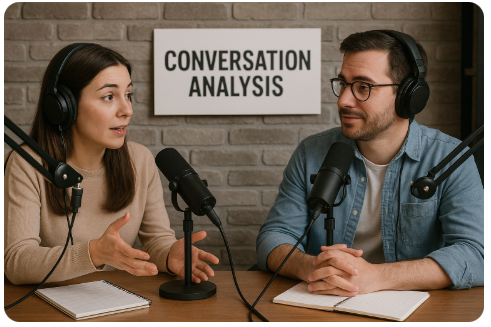
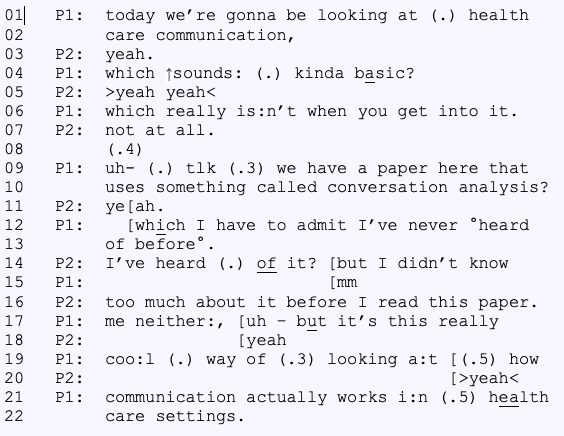
Image separately generated by ChatGPT to the prompt “Produce a realistic image of a male and female podcast duo, discussing a topic in Conversation Analysis”
A manual transcript of an early moment in the podcast

The AI podcasters manage to correctly convey some of CA’s methodological procedures such as the focus on the details of language-in-use, but then miss the mark by glossing over them as “little non-verbal cues” – which starkly misrepresents CA’s treatment of embodied resources.

From there on, it’s only downhill: one of the hosts claims that the review article “is really opening up this whole new world of understanding about how culture and context shape our communication in healthcare”, which is clearly at odds with CA’s take on (cultural) context as endogenously produced and managed. All of this in just the first four minutes. Plenty of material there to encourage the students to compare what they heard in the podcast with what they read in the original article – and with what I’ve been telling them in the lectures. There’s something about the plausibility of the podcast that makes the contrast sharp and meaningful, making the students more appreciative of what conversation analysis does actually mean.
Final reflections on using genAI in teaching CA

GenAI platforms have multiple educational applications. Many students use NotebookLM to organise study notes and revise for exams. Also, some educators claim that the podcasts may increase accessibility for diverse learners who benefit from listening rather than reading; but these claims have not yet been backed up by solid evidence. Furthermore, given that podcasts are littered with hallucinations, we seriously doubt they can substitute original materials.

When it comes to CA, which has a unique approach to social interaction, it’s no surprise that genAI struggles to provide accurate information. We don’t need to peek inside the “black box” of ChatGPT to recognise it’s been mainly trained on texts with a bias towards cognition. So, instead of asking ChatGPT to, for example, define a technical CA term, learners would profit from consulting the Encyclopedia of Terminology for CA and IL. Both are only a few clicks away, but only the latter provides reliable information that is transparently referenced.

At the beginning of each course, I (Bogdana) ask students if they have ever used genAI. For two years now, the answer has been almost unanimously yes. This strongly suggests genAI is here to stay in our classrooms, and in our lives. While I have mixed feelings about using genAI, especially due to privacy and environmental concerns, still I think it’s important for students to learn how to work with genAI in a responsible and critical manner.

Reference

Parry, R., & Barnes, R. K. (2024). Conversation-analytic research on communication in healthcare: Growth, gaps, and potential. Research on Language and Social Interaction57(1), 1-6.

Guest Blog: 93% of all misinformation is nonverbal: How a zombie statistic came and stayed

Students of language all too often have to sigh and turn away when they hear yet another expert claim that 75% – or is it 85%? Or 93%? – of communication is via body language. Where does this zombie stat come from, and why won’t it go away? I’m delighted that Gonen Dori-Hacohen has taken on the job of tracking it down, and it makes for some fascinating reading.

Gonen Dori-Hacohen, U Mass., Amherst

“Although some have suggested that as much as 93% of conversational meaning is communicated nonverbally (Mehrabian, 1968), more conservative estimates indicate that nonverbal behaviors account for 60 to 65% of the meaning conveyed in an interpersonal exchange (Birdwhistell, 1970; Burgoon, 1994). That is, even conservative estimates ascribe nearly twice as much meaning-making power to nonverbal communication as to verbal—and it is not difficult to understand why, given the number of nonverbal channels and the range of nonverbal behaviors to which people have access.” (Guerrero & Floyd, 2006, p. 2)

The claim that 60 to 93 percent of nonverbal communication is repeated and accepted. And it is nonsense. Not because much of current communication is mediated without bodies. It’s nonsense because imagine seeing me stating it in a TED talk, but in a language, you do not know. Will you understand 90% of the meanings? Or even 65%? You might understand some elements, like my stance, but that is it.

Indeed, Elizabeth Stokoe says that Max Atkinson had used this translation argument to get Mehrabian (the person wrongly cited as 1968 above) to admit that his argument was widely overblown (Stokoe, 2018). Communication is verbal and nonverbal, and reducing it to competition among different channels is wrongheaded, especially claiming that nonverbal is more important to meaning.

This blog is another attempt to explain how we got these claims. Mehrabian was the easy target, so we will get to him at the end, but what about Birdwhistell and his “conservative estimate”? It is probably a joke that has gone wrong.

Tracing the myth

Textbooks and handbooks spread this misinformation. They cite each other, and it took me three generations of books to get to the original research. Let us return to the textbook above (in turn cited as a source by Jones, 2024, a textbook my department wants to adopt). Nonverbal communication gives twice the “meaning” that verbal communication gives. This textbook cites Albert Mehrabian, Ray Birdwhistell and Judee Burgoon. Let’s start with Burgoon (1994), which is a chapter in a handbook (that keeps being reprinted) on interpersonal communication. Burgoon writes: “More reasonable estimate comes from Birdwhistell (1955), who claimed that 60 to 65 percent of the meaning in a social situation is communicated nonverbally. Although he offered no empirical evidence…” (Burgoon, 1994, p. 234). First, it is Birdwhistell’s 1970 and not 1955. Second, if Birtwhistell provided no evidence, why cite him? Burgoon herself cites Philpott’s (1983) MA thesis, a meta-analysis of nonverbal communication experiments, to support Birdwhistell’s claim. However, Birdwhistell and the MA thesis cannot align, mainly because, as we will soon see, the MA thesis quotes Birdwhistell without understanding what he meant.

We need not delve far into Phillpott’s (1983) MA thesis, but we do find him reoporting that Birdwhistell “estimates that ‘no more than 30 to 35 percent’ (1970, p. 157) of meaning is based on verbal information.” (p. 6). He continues: “[a]lthough Birdwhistell’s … figure is presented as no more than a ‘guess,’ it has come to be treated as gospel” (p. 6-7). Thus, like Borgoon, Phillpott acknowledges that Birdwhistell’s number is a “guess,” but it is accepted as a fact. In the remainder of the thesis, Phillpott combines the prior analyses, taking research that was disproven and the one that disproves it to achieve the numbers Borgoon cites. However, the MA thesis makes Birdwhistell a principal of the claim that 65% of communication is nonverbal.

Birdwhistell: Kinesics, Communication, and a Joke?

Ray Birdwhistell was influential in introducing the study of body language to various scientific disciplines. In his influential “Kinesics and Context” (1970) he was: “… trying to demonstrate the necessary interdependence of the kinesic and linguistic;” (p. 17). Interdependence: so, you would think, not separable.

However, when discussing gestures, Birdwhistell writes: “Our present guess is that in pseudostatistics probably no more than 30 to 35 per cent of conversation or interaction is carried by the words.” (1970, P. 157-158). The use of “guess,” the “pseudo” to refer to statistics, followed by a “probably” all suggest non-seriousness. Relatedly, “carrying a conversation” does not equal “meanings” in it. Considering the extreme attention Birdwhistell gave to context and his stress on the interdependence of all communication channels, this sentence probably mocks the “x percent of meaning being verbal or nonverbal” research. Nonetheless, this half-joking sentence is taken as Birdwhistell’s legacy and then used as the “more conservative” finding by people who probably have not read another word Birdwhistell wrote.

Mehrabian: Experimenting with variance

“[A]s much as 93% of meaning in any interaction is attributable to nonverbal communication. Albert Mehrabian asserts that this 93% of meaning can be broken into three parts (Figure 5.2).4 Mehrabian’s work is widely reported and accepted.” Fn 4. Mehrabian, A. (1971). Silent messages. Wadsworth.(Quote from Wrench et al. 2020, pp. 159-160).

To be fair, Mehrabian (1971) never claimed the statistic in first sentence. He was interested in “inconsistent communication” (Mehrabian, 1971 p. 42) where “we may express something verbally while our facial expressions [16], posture [111], tone of voice [73, 150, 161], or gestures [39] say the opposite.” (p. 142) From these situations, the myth starts:

“we can say that a person’s nonverbal behavior has more bearing than his words on communicating feelings or attitudes to others. The equation we just presented is a generalization of the research on liking. Total feeling = 7% verbal feeling + 38% vocal feeling + 55% facial feeling”   (1971, p. 44)

This text apparently establishes that verbal only explains seven percent of the expression of feeling, while nonverbal, tonal and facial together, account for 93%, the mythical number. The claim is based on two lab experiments with a similar method.

UCLA students were exposed to two channels of communication, either verbal and tonal (Mehrabian & Wiener, 1967) or tonal and facial expressions (Mehrabian & Ferris, 1967). The channels deliver different stances of the emotion of “likeness,” e.g., if the tone suggested liking, the words did not or if the tone was neutral, the facial expression was not. The students were asked about the meanings of the message, either separated by channel or combined. At the last paragraph of the second paper (Mehrabian & Ferris, 1967), a cumulative result is presented: “[t]he combined effect of simultaneous verbal, vocal, and facial attitude communications is a weighted sum of their independent effects— with the coefficients of .07, .38, and .55, respectively.” (Mehrabian & Ferris, 1967, p. 252)

This conclusion is problematic. Each paper presents self-disclosed limitations, and the combination is not well discussed. Moreover, Mehrabian’s argument is based on many generalizations: lab setting; limited undergraduate population; UCLA;[1] only female speakers; one word (in Mehrabian & Ferris, 1967) or a single-uttered word (Mehrabian & Wiener, 1967); still photo (Mehrabian & Ferris, 1967); tonal expression (Mehrabian & Wiener, 1967); and one emotion, liking. Even then, Mehrabian only explains the variance in meaning, i.e. how much a channel explains regarding their inconsistency. This fact is usually overlooked. Worse still, even Mehrabian never generalized to all meanings or “Communication:” he studied emotions. Lastly, his analyses were faulty (Borgoon, 1994). Birdwhistell would vehemently reject every element of Mehrabian’s work.[2] None of these shortcomings prevents textbooks from citing Mehrabian, and then associating him with Birdwhistell to promote the myth of how important nonverbal communication is.

The Alternative View

For ROLSI readers, presenting the alternative is almost not needed. Mehrabian took the outlier of inconsistency between the channels and made it the center. Birdwhistell and Goffman acknowledged that there could be misalignment between communication channels, but they assumed they usually work together. Following Birdwhistell, Adam Kendon posits: “detailed studies of how gesture and speech are interrelated (…) have shown that these two activities are so intimately connected that they appear to be governed by a single process….It has become clear that visible bodily action is often integrated with speech in such a way as to appear as if it is its partner and cannot be disregarded” (2004, p. 3). Goodwin (1979) suggested the intricate relations between gaze and talk and Streek (1993) demonstrated how hand gestures are coordinated with talk.

I’ve deliberately chosen to present such “older” research to demonstrate that the interdependence between verbal and nonverbal is well-established. However, this research is ignored in favor of the 60-93% myth in many interpersonal communication textbooks and mundane outlets. Why does the competitive view between verbal and nonverbal communication, in which the latter wins, continue? Alternatively, who gains from spreading this misinformation?

Conclusion: Agents of misinformation

There are competing views on communication. One starting point is the psychological side: communication resides in the individual, who controls and can change their communication if they choose to or are taught to. Communication can be broken into discrete channels, motions, and utterances and studied in a laboratory outside of context.

Using Birdwhistell (1970) for such a claim is an affront. Birdwhistell argued the opposite: “John does not communicate to Mary, and Mary does not communicate to John; Mary and John engage in communication.” (1970 p. 12) Nonverbal and verbal cannot be separated, and separating a discrete element is close to impossible.

The misinformation regarding nonverbal communication is hard to counter since interdependence is harder to sell. It becomes disinformation since many trainers will teach you how to change your nonverbal communication to win friends and influence people (Carnegie, 1934/2022). If you sign up for my workshop on nonverbal communication, your life will change forever because 93% of all communication is …. To uproot this misconception, we need to point it out, show its stupidity and fallacious roots, preach its alternative, and discuss its reasons. If I’ve tried to achieve that here, and failed, it would probably be because only seven percent of the text had any meaning, since 93% of communication is still considered by too many to be nonverbal…

References

Birdwhistell, R. L. (1970). Kinesics and context: Essays on body motion communication. University of Pennsylvania press.

Burgoon, J. K., (1994). Nonverbal signals. In M.L. Knapp & G. R. Miller (Eds.) Handbook of interpersonal communication (pp. 229-285). Sage.

Carnegie, D. (1934/2022). How to win friends and influence people. DigiCat. 

Goodwin, C. (1979). The interactive construction of a sentence in natural conversation. Everyday language: Studies in ethnomethodology97, 101-121.

Guerrero, L. K., & Floyd, K. (2006). Nonverbal communication in close relationships. Routledge.

Jones JR., R.G. (2024). Communication in the Real World (ver. 3). Flatworld Publication

Kendon, A. (2004). Gesture: Visible action as utterance. Cambridge University Press.

Mehrabian, A. (1971). Silent messages (Vol. 8, No. 152, p. 30). Belmont, CA: Wadsworth.

Mehrabian, A., & Ferris, S. R. (1967). Inference of attitudes from nonverbal communication in two channels. Journal of consulting psychology31(3), 248-252.

Mehrabian, A., & Wiener, M. (1967). Decoding of inconsistent communications. Journal of personality and social psychology6(1), 109-114.

Philpott, J. S. (1983). The relative contribution to meaning of verbal and nonverbal channels of communication: A meta-analysis. Unpublished MA thesis. The University of Nebraska.

Stokoe, E. (2018). Talk: The science of conversation. Hachette UK.

Streeck, J. (1993). Gesture as communication I: Its coordination with gaze and speech. Communications Monographs60(4), 275-299.

Wrench, J. S., Punyanunt-Carter, N. M., & Thweatt, K. S. (2020). Interpersonal communication: A mindful approach to relationships. Milne Open Textbooks.


[1] I am a UCLA alumnus.

[2] On labs Birdwhistell wrote: “We cannot study the social behavior of a fish by taking him out of the water. The child is a child in his world – the pieces he displays in a laboratory represent a very small and, perhaps, unrepresentative sample of his repertoire.” (1970, p. 6) Similarly he rejected a fixed meaning to a fixed gesture.

A new bibliography of all articles in ROLSI, 1987-2022

Back in 2015, Maurice Nevile tracked down and listed every single article published in ROLSI between 1987 and 2014. That was an enormous feat of scholarship, and now he’s updated the catalogue.

Maurice Nevile, University of Canberra

Now Maurice’s 2023 revised version of the bibliography presents, in chronological order, all items published in the journal ROLSI, from 1987 to 2022 (excluding editor comments).

The list makes it easier to view the journal’s contents at a glance, or to track and find specific items, authors, analytic interests and phenomena, settings and situations, or data languages, etc. The list begins in 1987, when the journal changed its name and orientation, after starting in 1969 as Papers in Linguistics.

Continue reading

Guest Blog:  Building an EMCA community at CADSS

Groups of EM/CA analysts have sprung up all over the world to share expertise, pore over data together, bounce ideas off each other and provide a sense of shared community. Here Simon Stewart gives an enthusiastic account of recent developments of the group based on the south coast of England.

Simon Stewart, Southampton

This post is intended to share with the CA community some of the resources and learning that have come from our group, CA Data Sessions South (CADSS), in its first 18 months.

Continue reading

Guest blog: Sharing CA with the public at a research festival

CA is blessed with some exceptionally able communicators, and there is a growing appetite to reach out to members of the public with a show of what CA can do (see the other blogs in this “CA Teaching” section). One now well-established tradition is for members of York’s Centre for Advanced Studies in Language and Communication (CASLC) to engage in York’s research festival (“Yornight“), and I’m delighted that Rose Rickford has sent in a report of what happened this year. Continue reading

Guest blog: Rebecca Clift on teaching CA in China

The global reach of Conversation Analysis is ever-expanding, as illustrated by the interest generated in CA workshops wherever in the world they take place. Here Rebecca Clift gives us a brief but evocative account of her trip to China with colleagues from the UK and the USA.

Screenshot 2019-08-02 at 10.10.56

Rebecca Clift, Essex University

There was a happy gathering for the third National Workshop in Conversation Analysis at Shanxi University, China, from 15th-19thJuly 2019. The huge group photo (see the  foot of the page) more or less gets everyone in! Continue reading

Guest blog: How to make CA fun for 182 kids (and 171 adults)

How do you make Conversation Analysis intelligible to children? And make it enough fun that they actually want to see how it works, and try it out? That is the challenge happily taken on by the enterprising team of postgraduate students Reihaneh Afshari Saleh, Zhiying Jian, Marina Cantarutti and Yumei Gan. I’m delighted that they agreed to write it up; their report makes for lively reading.

Screenshot 2019-06-24 at 09.40.54.png

Zhiying Jian, Marina Cantarutti, Yumei Gan and Afshari Saleh

One of the most fulfilling things when doing our sometimes lonely PhD research is being told that what we do matters. Public engagement gives you a chance to experience that. We know that making our research accessible to the public can be daunting, and when your audience is potentially 200 kids aged 5-11, even more so! The PhD students in Language and Communication at the University of York, Reihaneh Afshari Saleh, Zhiying Jian, and Marina Cantarutti, and our PhD student visitor from the Chinese University of Hong Kong, Yumei Gan, decided to rise to the challenge and make Conversation Analysis (even more) fun! Continue reading

Guest blog: Ruth Parry on how to use analogies to introduce CA to new audiences

CA research is increasingly finding application to real-world problems, but getting its virtues across to a lay audience – and potential collaborators – is not always easy. I’m delighted that Ruth Parry, who has extensive experience, has agreed to let us into some of the tips and tricks of the trade – especially the power of using analogies to get the message across.

Ruth head&shoulders

Ruth Parry, Loughborough University

When your scientific approach is one few people have heard of, is pretty technical, and has a conventional title that doesn’t help much (or could even mislead), tried and tested ways to introduce and explain it are a boon. In this blog I describe some ways to explain conversation analysis to others – whether we’re presenting our research, delivering CA-based training, or building collaborative projects with teams from diverse backgrounds. Continue reading

Guest Blog: Marina Cantarutti on presenting CA to the public

Explaining what we do to the general public can be a daunting exercise, but the rewards can be well worth it.  Marina Cantarutti, doing her doctoral research at the University of York, took on the task, and presented her work at a science fair of the kind that hosted Saul Albert and colleagues’ excellent CA Rollercoaster. She lived to tell the (happy) tale…

Screenshot 2018-11-19 at 15.55.41
Marina Cantarutti, University of York

For some areas of linguistics, it may be a bit difficult to make your work accessible to the public without feeling you are betraying yourself, or your knowledge. The fear of trivialising is always at the back of one’s mind. Moreover, when you’re out there on your own, you are the sole representative of the discipline … daunting! Continue reading