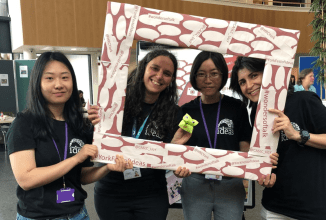
CA is blessed with some exceptionally able communicators, and there is a growing appetite to reach out to members of the public with a show of what CA can do (see the other blogs in this “CA Teaching” section). One now well-established tradition is for members of York’s Centre for Advanced Studies in Language and Communication (CASLC) to engage in York’s research festival (“Yornight“), and I’m delighted that Rose Rickford has sent in a report of what happened this year. Continue reading
Category Archives: Guest Blogs
Guest Blog: How does a market trader get customers?
In a recent paper in ROLSI, Kenan Hochuli reported a remarkable study of the complex world of the street market. I’m delighted that he’s prepared a guest blog on the subject, concentrating on the crucial step in the selling process: getting the passer-by to stop.

Kenan Hochuli, Neuchâtel and Zurich
Market stalls are unique service institutions. They are located in public spaces and approachable from different directions. There are no material or technical devices that determine the sequence of sales. Sometimes it is not clear whether a person is just passing by a stall or if they intend to buy something. And this often happens in the course of already ongoing sales interactions. In view of these conditions, my article deals with seller’s efforts in transforming passers-by into customers and, more generally, participants negotiation of co-presence in the course of emerging multi-party-encounters. Continue reading
Guest Blog: PeaceTalk – Talk and Interaction in Multinational Crisis Management Training
Conversation Analysis is finding application in all sorts of fields, and perhaps none so sensitive as military manouevres… but as Antti Kamunen explains, it can all be in the service of defusing a crisis and working towards peaceful resolution.

Antti Kamunen, Oulu
What happens inside a patrol car when you notice you are about drive into a minefield? How do you act when you suddenly come across a life-threating situation and have to make decisions quickly? What happens when you get lost on your patrol route in a potentially hostile territory? Continue reading
Guest Blog: the Danish DanTIN group and The Grammar of Everyday Life
Denmark has a thriving EM/CA community, with faculty and students contributing to world-class initiatives across the range of interaction research. Here Magnus Hamann tells us how Danish Interaction Linguistics grew from a simple idea to an project that has generated activity and funding for generations of postgraduate students.

Magnus Hamann
DanTIN project has its 10-year anniversary. in November 2019. Happy students from different stages of life (some still students, some already accomplished contributors to the work force) have met to celebrate something that has probably had a bigger influence on their linguistic studies and identity than they had initially realised. Continue reading
Guest blog: Grammar from head to toe: Reporting on the Grammar-body interface colloquium
A recent meeting in Neuchâtel will be of much interest to ROLSI.net blog readers – the reciprocal connection between grammatical abstractions and their embodied realities is at the centre of theoretical debates in interactional linguistics. I’m delighted that a group of energetic young scholars from the Center for Applied Linguistics, University of Neuchâtel have sent in this lively report of proceedings.
Authors: (in alphabetical order): Sophia Fiedler, Kenan Hochuli, Loanne Janin, Adam Jones, Klara Skogmyr Marian, Ioana-Maria Stoenica
Grammar and the body Continue reading
Guest blog: Rebecca Clift on teaching CA in China
The global reach of Conversation Analysis is ever-expanding, as illustrated by the interest generated in CA workshops wherever in the world they take place. Here Rebecca Clift gives us a brief but evocative account of her trip to China with colleagues from the UK and the USA.

Rebecca Clift, Essex University
There was a happy gathering for the third National Workshop in Conversation Analysis at Shanxi University, China, from 15th-19thJuly 2019. The huge group photo (see the foot of the page) more or less gets everyone in! Continue reading
Guest blog: Displaying understanding of visible and imagined objects
Among the articles in ROLSI 52 (1) was a fascinating account of what people do when looking at (or being asked to think about) museum objects. I’m delighted that the authors, Chie Fukuda and Matt Burdelski, agreed write a piece to illustrate their study in shorter form.

Chie Fukuda

Matt Burdelski
Multimodal/multisensorial analyses of situated interaction have increasingly focused on the role of objects (along with talk and other semiotic resources) in producing social action. But what actually happens in the interaction between guide and visitor?
Our collaborative effort in examining guided tours as situated activities within museums and culture centers has led us to examine how objects are brought into being and deployed in interaction, and how recipients display their understanding of them. Continue reading
Guest blog: How to make CA fun for 182 kids (and 171 adults)
How do you make Conversation Analysis intelligible to children? And make it enough fun that they actually want to see how it works, and try it out? That is the challenge happily taken on by the enterprising team of postgraduate students Reihaneh Afshari Saleh, Zhiying Jian, Marina Cantarutti and Yumei Gan. I’m delighted that they agreed to write it up; their report makes for lively reading.
Zhiying Jian, Marina Cantarutti, Yumei Gan and Afshari Saleh
One of the most fulfilling things when doing our sometimes lonely PhD research is being told that what we do matters. Public engagement gives you a chance to experience that. We know that making our research accessible to the public can be daunting, and when your audience is potentially 200 kids aged 5-11, even more so! The PhD students in Language and Communication at the University of York, Reihaneh Afshari Saleh, Zhiying Jian, and Marina Cantarutti, and our PhD student visitor from the Chinese University of Hong Kong, Yumei Gan, decided to rise to the challenge and make Conversation Analysis (even more) fun! Continue reading
Guest blog: Ruth Parry on how to use analogies to introduce CA to new audiences
CA research is increasingly finding application to real-world problems, but getting its virtues across to a lay audience – and potential collaborators – is not always easy. I’m delighted that Ruth Parry, who has extensive experience, has agreed to let us into some of the tips and tricks of the trade – especially the power of using analogies to get the message across.

Ruth Parry, Loughborough University
When your scientific approach is one few people have heard of, is pretty technical, and has a conventional title that doesn’t help much (or could even mislead), tried and tested ways to introduce and explain it are a boon. In this blog I describe some ways to explain conversation analysis to others – whether we’re presenting our research, delivering CA-based training, or building collaborative projects with teams from diverse backgrounds. Continue reading
Guest Blog: the 11th EMCA Doctoral Network – Manchester, May 2019
The Ethnomethodology and Conversation Analysis (EM/CA) Doctoral Network is now an established part of the UK postgraduate scene, and highly prized by the students who attend its biannual meetings. I’m delighted that Yumei Gan, from the Chinese University of Hong Kong (and a visiting research student at University of York) sent in this lively report of the most recent event.

Yumei Gan; Video Analysis, Science, and Technology (VAST) Research Group; The Chinese University of Hong Kong
I first heard about the EMCA Doctoral Network through Facebook, on the recommendation of my supervisor Christian Greiffenhagen. For a long time, I only treated this ‘network’ as a virtual ‘network’, I never really thought that there would be the possibility of physically meeting other doctoral students doing EMCA research. In May 2018, when Jon Hindmarsh visited Hong Kong, he mentioned that he was preparing the 10th EMCA Doctoral Network in London. That was the first time when I knew this ‘network’ is not virtual, but can be and is actually ‘face-to-face’. Continue reading