Category Archives: Guest Blogs

Guest Blog: Groningen Symposium on Language and Social Interaction

The second meeting on language and social interaction in Groningen, was a welcome addition to the burgeoning collection of small and medium-sized CA events in Europe. Tom Koole and Mike Huiskes, the organisers, have kindly sent in a brief account of the day in  this delightful city in the north of the Netherlands.

Tom Koole

Tom Koole

Mike Huiskes

Mike Huiskes

On January 22 2016 we celebrated the 2nd in the series of the Groningen Symposium on Language and Social Interaction (GSLI).

The one-day GSLI symposium (www.gsli.nl) takes place every year in January in Groningen and has a different theme each year. The University has some historic buildings, and we held the meeting in a classical lecture theatre – venerable, but somewhat on the austere side, with seating to keep the participants awake and attentive! Continue reading

Guest Blog: The 9th CA Day at Loughborough

To complement our earlier report on the 9th CA Day (see the previous blog for the organisers’ view), I’m delighted that Mika Ishino, on behalf of herself, Ritsuko Izutani and Aya Jodoji, all from the Applied Conversation Analysis Working Group at Osaka University, Japan (site in Japanese) has sent in this lively and comprehensive guest blog.

Screen Shot 2016-01-18 at 22.35.52

Continue reading

Loughborough CA Day 2015: Conversation Analysis and Cake

Every year since 2006 we’ve put on a day of Conversation Analysis talks at Loughborough University, under the aegis of the Discourse and Rhetoric Group (DARG). This year, the 9th, was another happy mix of the scholarly and the convivial. A subsequent guest blog will give an attender’s-eye view, but in the meantime here are some reflections from us as organisers.

The first thing to say is that CA is in very rude health:  once again the demand for registration was very strong, and the submissions to present papers were of high quality. That meshes with our experience of other conferences and meetings, large and small, over the last decade: a lot of people like what CA does, and want to see more of it, be it out of conviction or curiosity.

Being an informal, rather end-of-term gathering, we could mix the presentations to showcase established authorities (like Rose McCabe, on CA and psychiatric consultation) and rising stars.

Screen Shot 2015-12-18 at 22.41.42.png

Rose McCabe – psychiatric consultations
Screen Shot 2015-12-18 at 22.39.27.png

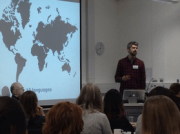
Kobin Kendrick – universality of expansion sequences

A surprising but welcome feature was the range of work on medical interaction – as well as McCabe on psychiatry, we had intriguing presentations on dentistry from Lewis Hyland, doctor-doctor consulatins from Marzia Saglietti and a team led by Fiona Stevenson;  and, rather movingly, Ruth Parry and Marco Pino on end-of-life conversations between hospice doctors and terminal patients in their care. The medical strand was perhaps a consequence of the (comparative!) ease, or lesser difficulty, of attracting research funding; but it is good stuff, and speaks well for CA’s robustness as it moves from private study to public application.

Among the other stand-out presentations were Kobin Kendrick on the universality of expansion sequences, and Sue Speer on the ambiguity of flirting, (including some squirm-inducing videoclips, always a bonus in a conference prsesentation).
Screen Shot 2015-12-18 at 22.40.21.png

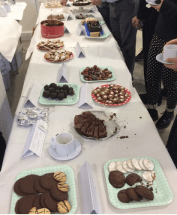
CA-ke-off contenders

As organisers we could take great pleasure in seeing some young, early-career researchers start to announce themselves to the CA tribe. Talks by Hatice Ergul, Marika Helisten, Angeliki Balantani and Brian Due covered topics all the way from assessments and accountability to activity resumption and object-passing, respectively. An audience of 60 peers and seniors would normally be daunting, but the friendliness of the occasion (helped by an exceptionally well-provisioned cake contest) calmed nerves.

We also had a prize draw for a couple of blockbuster CA titles, kindly donated by the publishers – we rigged it so that only doctoral students could win, but don’t tell anyone.
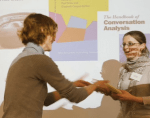
Sue Speer presents prize to Linda Walz

Sue Speer presents a prize to Linda Walz

Next year will be our tenth. Each year we think up a suitably broad title to fly under – we have had such permissive themes as “Interaction and Home and at Work”, “Structures of Action”  and “Conversational Sequences”, in a bid to attract all comers. For the 10th anniversary meeting, perhaps we’ll just stick with “The Pleasures of Conversation Analysis“. That’ll capture it pretty well.

Charles Antaki and Liz Stokoe, with thanks to our team of postgraduate volunteers: Marc Alexander, Kat Connabeer, Joe Ford, Emily Hofstetter and Bogdana Huma.

Screen Shot 2015-12-22 at 12.37.32L to R: Charles, Liz, Joe, Emily, Bogdana and Marc

Guest Blog: Language in Later Life

I’m delighted that Barbara De Cock and Andrea Pizarro Pedraza from the Université Catholique de Louvain have agreed to write a report on this excellent meeting. Older people tend to be ignored in much language research, and this conference hosted by their university was a welcome way of redressing the balance. Conference images courtesy of Thi Ngoc Linh Tran. Continue reading

Guest Blog: An Ethno/CA Network meet in the land of the Ethnos

Our new blog is by Joe Ford, Bogdana Huma, Lin Wu, Marc Alexander, Fabio Ferraz-de-Almeida and Yeuning Yang, all doctoral students at Loughborough University. They attended a busy and thought-provoking Ethnomethodology / Conversation Analysis training day in Manchester. There was something of a culture clash, as their lively report reveals… Continue reading

From the latest issue: Why talk now?

Elliott Hoey has a fascinating article in the current issue of ROLSI (viewable here). What happens when there’s silence between people? Are all silences the same? Does everyone have equal rights to break it? Elliott has provided a very lively short version of his article as the blog below, and you can (if you have access) read the full piece here.  Continue reading

Guest Blog: Conversation Analysis and online communication

One of the fastest-growing areas of CA-inspired research is in the field of computer-mediated communication – everything from human-machine interaction through to synchronous and asynchronous social media.  In this very welcome guest blog, Jo Meredith, Trena Paulus, Wyke Stommel and David Giles send in a report on the 3rd International Symposium for the Micro-analysis Of Online Data: Online communication, discourse and context, a significant meeting of cutting edge research.

Jo Meredith, Salford University

Jo Meredith, Salford University

Trena Paulus, Univetsity of Georgia

Trena Paulus, Univetsity of Georgia

Wyke Stommel, Radboud University

Wyke Stommel, Radboud University

David Giles, University of Winchester

David Giles, University of Winchester

Continue reading

Guest Blog: Maurice Nevile on transcribing Gail Jefferson

A talk by Gail Jefferson, one of the founders of Conversation Analysis, has been recently made available, and Maurice Nevile undertook to transcribe it for the benefit of the language-in-interaction community. Here he reports on what it meant to him, and what we can all get out of such a powerful historical document.

Maurice Nevile, University of Southern Denmark

Maurice Nevile, University of Southern Denmark

Transcribing Gail Jefferson: The 1977 Boston talk as it actually was

When I first saw the film recording of Gail Jefferson presenting at the 1977 Boston University Conference on Ethnomethodology and Conversation Analysis I was immediately keen to transcribe it. Continue reading

Guest Blog: A bonus IPrA track – was conversation “built for two”?

As a bonus to the guest blogs the on IPrA conference, I’m delighted that Elliott Hoey has accepted an invitation to contribute a report on Tanya Stivers’ keynote address. This was one of the most thoughtful and original presentations, raising as it did the question: did the evolution of talk favour two, and only two, people?

Elliott Hoey, Max Planck Institute, Nijmegen

Elliott Hoey, Max Planck Institute, Nijmegen

The taskmasters at IPrA convinced a sizeable crowd to attend an 8:30am plenary talk by Tanya Stivers, who suggested that conversation is “built” for dyadic interaction. Her abstract can be found here.  The following is not verbatim reporting, but simply what I recall. Continue reading