
CA scholars are proving increasingly inventive at engaging their students with the science and craft of the discipline. We have already featured a blog about using an AI podcast to help students work their way through an academic research paper, and one of the most frequently visited blog pages on this site is a long list of video clips which illustrate CA practices for use in teaching. Here I’m delighted to feature an intriguing new teaching resource developed by Maartje Roodzant and Borbala Sallai at the Radboud Universiteit, Nijmegen.
Can teaching CA be gamified?
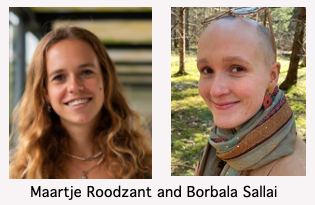
How to educationally entertain (or entertainingly educate?) a group of 15 scholars of social interaction? This is the question we asked ourselves recently when we were tasked with organizing a teambuilding day for our research group Language and Social Interaction (LanSI) at Radboud University in the Netherlands. The answer came to us in the form of a game of ‘CA Memory’: a brainchild of the first author.
In this blog post, we will tell you about this game, how it was created, and how it can be applied for various academic purposes, while also reflecting on how this game fits in the trend towards gamification in science.
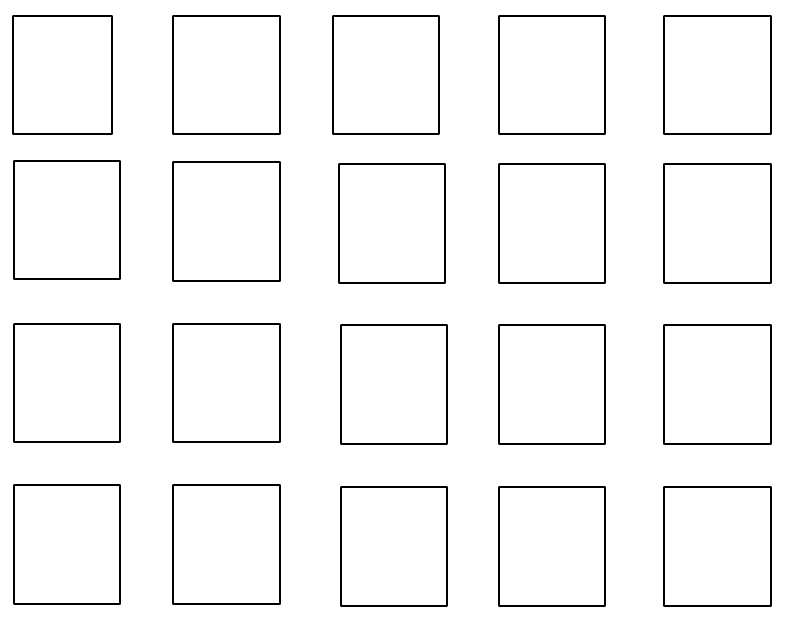
First we prepared a set of cards. One set was made up of abstracts of an academic paper that studied a certain phenomenon; the other set was made of matching short clips from a movie or tv show which featured a salient (we hoped!) instance of those phenomena. The cards were mixed up and placed face down on the floor.
When a card with a number was uncovered, we played the corresponding clip to the players; if it was an abstract, the players read it and discussed it.. Then the card was placed face down again, and as the game went on and the players had got an idea of where the cards were, they had to pair them up.
The game
The objective of the game is basically to identify and remember those pairs. Players were divided into teams to speed up the game and to make it more engaging. Then, it was finally time to start playing the game, using the following rules:
- Mix the cards and lay them face-down on the floor, arranging them in a big square (classic memory-style). Discuss the rules:
a. Is note-taking allowed?
b. What is the maximum time for teams to confer during their turn? - The team with the youngest player starts.
- Upon each turn, one team member flips over two cards at a time.
- The corresponding video clips and abstracts are shown on a big screen to ensure visibility for all players. Note:
a. Each fragment is only shown once per turn.
b. A predetermined amount of time will be allocated to read the abstract upon first appearance (e.g., 2 minutes).
c. It is possible that players end up with two abstracts or two fragments in one turn. - When the team thinks they have a match, they ask the jury to assess.
a. If the match is correct, the team claims the pair and takes another turn.
b. If the match is incorrect, the team flips the cards back over and the next team takes their turn. - The game ends when all the correct pairs are claimed. The team with the most pairs wins.
Try it yourself
Would you like to try the game out for yourself? We won’t make you do the memory version, but at least you can see if you can match up the cards! We’ve helped by turning the cards over already. Click on the numbered tiles to open the video clips, then see if you can pair the card with an Abstract. (You can check your guesses with the answers at the foot of this blog.)
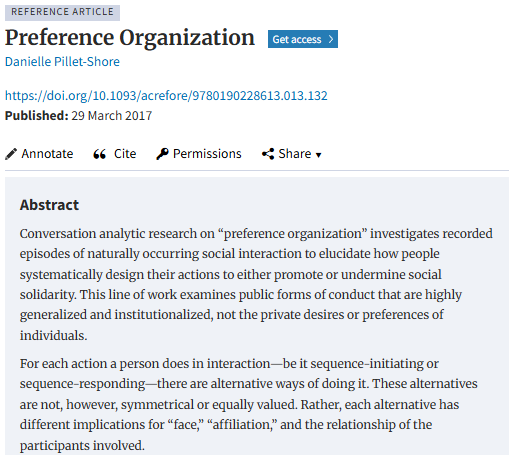
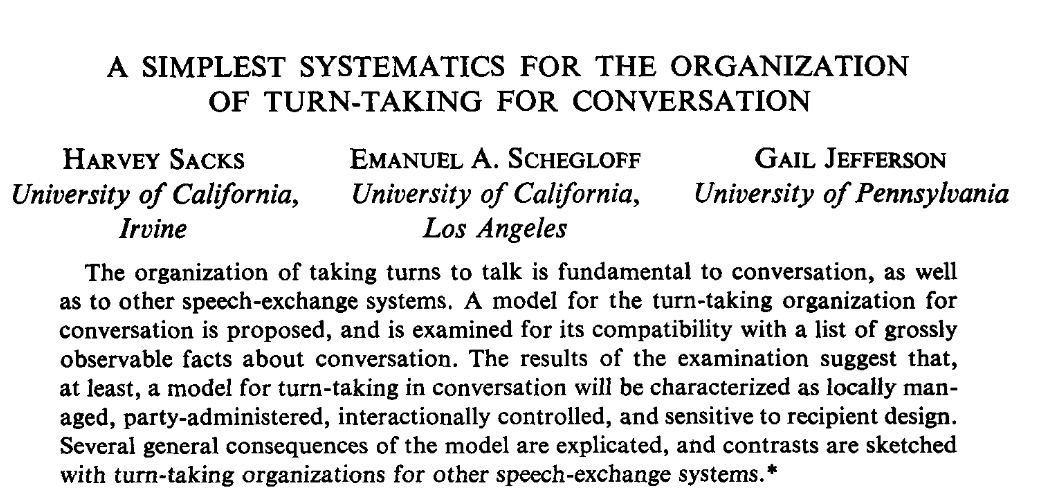
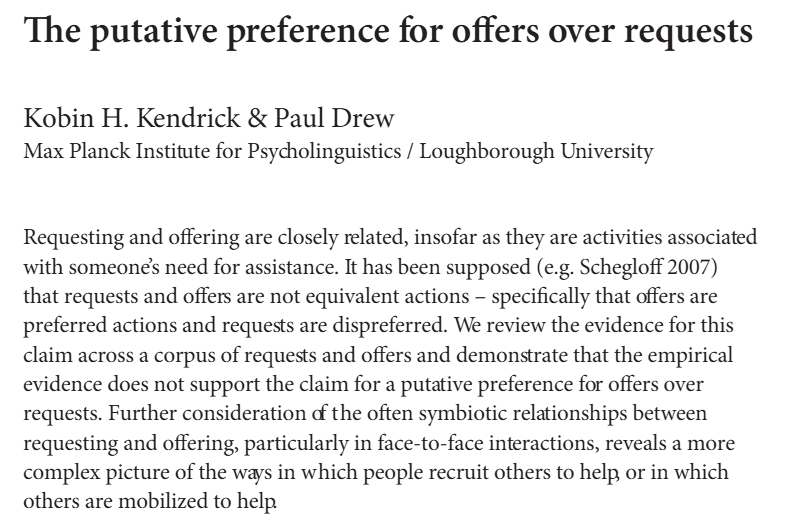
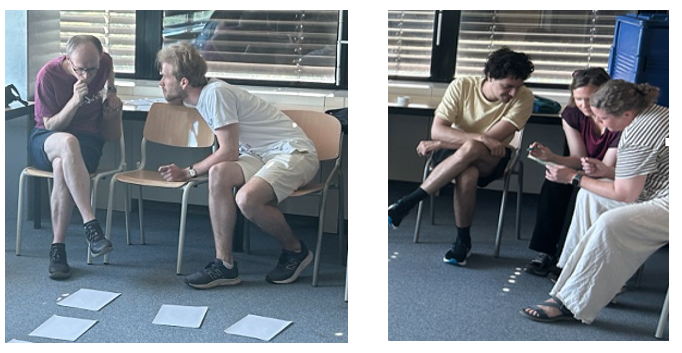
Game play The team typically spread out the cards in front of them on the floor, and puzzled over them for some time.
How did it go?
Did this go entirely without struggle? Of course not.
Try to put some critical (CA) scholars in a room, show them a fragment, and you will definitely get some fairly argumentative exchanges. Isolating a single interactional phenomenon in a 30-second clip, especially when one does not know what they are looking for, is quite a challenge. Lots of discussions – within teams, between teams and between the jury and teams – arose. Not only did this make the game more fun, but it also allowed for data session-style collaborative thinking.
Overall, it turned out to be a very fun and rewarding activity, with lots of potential for applications outside of our own teambuilding day.
Adapting CA Memory for various settings
Building on our experience with CA Memory, we propose that it could be used for a variety of (semi-)academic purposes, including:
- teaching CA, as it helps engage with literature in a playful setting,
- as an ice-breaker activity for a conference,
- in a research group to get to know each other’s research,
- etc.
Virtually any aspect of the game can be adapted depending on the audience and intended outcome. You can adjust the gameplay process, the level of difficulty and the content as you like. For example, you could (dis)allow note-taking, turn it into a puzzle instead of memory (by showing all fragments + abstracts at once and letting the participants find the matches), or allow for preparatory reading. The game also lends itself well to being ‘recipient-design’-ed, by adding papers and fragments based on the course curriculum or the scientific output of the players – in our case, this was well received.
If you want to create your own version, you could use the video clips in this ROLSI blog of video clips which illustrate CA practices. If you have any further questions, feel free to reach out to Bori (borbala.sallai@ru.nl) or Maartje (maartje.roodzant@ru.nl).
- Check if you got the connections. The correct matches between number and abstract:
- 1 = Preference organisation
- 2 = The putative preference for offers over requests
- 3 = A simplest systematics for the organisation of turn-taking for conversation

