
In spite of their divergent research paths, ethnomethodologists and conversation analysts have much in common, and it’s good to see established members of the community offer joint workshops to the up-and-coming generation. Here Veronica González and Maria Vanessa aus der Wieschen give a lively report on the latest EM/CA “bootcamp”. Continue reading
Loughborough CA Day 2015: Conversation Analysis and Cake
Every year since 2006 we’ve put on a day of Conversation Analysis talks at Loughborough University, under the aegis of the Discourse and Rhetoric Group (DARG). This year, the 9th, was another happy mix of the scholarly and the convivial. A subsequent guest blog will give an attender’s-eye view, but in the meantime here are some reflections from us as organisers.
The first thing to say is that CA is in very rude health: once again the demand for registration was very strong, and the submissions to present papers were of high quality. That meshes with our experience of other conferences and meetings, large and small, over the last decade: a lot of people like what CA does, and want to see more of it, be it out of conviction or curiosity.
Being an informal, rather end-of-term gathering, we could mix the presentations to showcase established authorities (like Rose McCabe, on CA and psychiatric consultation) and rising stars.

Rose McCabe – psychiatric consultations
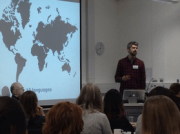
Kobin Kendrick – universality of expansion sequences
A surprising but welcome feature was the range of work on medical interaction – as well as McCabe on psychiatry, we had intriguing presentations on dentistry from Lewis Hyland, doctor-doctor consulatins from Marzia Saglietti and a team led by Fiona Stevenson; and, rather movingly, Ruth Parry and Marco Pino on end-of-life conversations between hospice doctors and terminal patients in their care. The medical strand was perhaps a consequence of the (comparative!) ease, or lesser difficulty, of attracting research funding; but it is good stuff, and speaks well for CA’s robustness as it moves from private study to public application.
Among the other stand-out presentations were Kobin Kendrick on the universality of expansion sequences, and Sue Speer on the ambiguity of flirting, (including some squirm-inducing videoclips, always a bonus in a conference prsesentation).
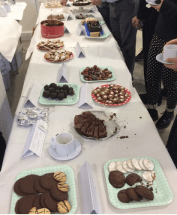
CA-ke-off contenders
As organisers we could take great pleasure in seeing some young, early-career researchers start to announce themselves to the CA tribe. Talks by Hatice Ergul, Marika Helisten, Angeliki Balantani and Brian Due covered topics all the way from assessments and accountability to activity resumption and object-passing, respectively. An audience of 60 peers and seniors would normally be daunting, but the friendliness of the occasion (helped by an exceptionally well-provisioned cake contest) calmed nerves.
We also had a prize draw for a couple of blockbuster CA titles, kindly donated by the publishers – we rigged it so that only doctoral students could win, but don’t tell anyone.

Sue Speer presents a prize to Linda Walz
Next year will be our tenth. Each year we think up a suitably broad title to fly under – we have had such permissive themes as “Interaction and Home and at Work”, “Structures of Action” and “Conversational Sequences”, in a bid to attract all comers. For the 10th anniversary meeting, perhaps we’ll just stick with “The Pleasures of Conversation Analysis“. That’ll capture it pretty well.
Charles Antaki and Liz Stokoe, with thanks to our team of postgraduate volunteers: Marc Alexander, Kat Connabeer, Joe Ford, Emily Hofstetter and Bogdana Huma.
 L to R: Charles, Liz, Joe, Emily, Bogdana and Marc
Guest Blog: Language in Later Life
I’m delighted that Barbara De Cock and Andrea Pizarro Pedraza from the Université Catholique de Louvain have agreed to write a report on this excellent meeting. Older people tend to be ignored in much language research, and this conference hosted by their university was a welcome way of redressing the balance. Conference images courtesy of Thi Ngoc Linh Tran. Continue reading
Guest Blog: An Ethno/CA Network meet in the land of the Ethnos
Our new blog is by Joe Ford, Bogdana Huma, Lin Wu, Marc Alexander, Fabio Ferraz-de-Almeida and Yeuning Yang, all doctoral students at Loughborough University. They attended a busy and thought-provoking Ethnomethodology / Conversation Analysis training day in Manchester. There was something of a culture clash, as their lively report reveals… Continue reading
From the current issue: Turn-taking in the skate pool
The second article from Volume 48 issue 4 that we feature is by Jonas Ivarsson. Jonas has been doing some ethnography with skateboarders, and seeing how their interaction plays to conversational rules. He and his co-author Christian Greiffenhagen have written it up in the journal here. This is a lively summary of some background, and some subtle analytical work on the standard Sacks-Schegloff-Jefferson model.

Jonas Ivarsson, University of Gothenburg
A few years ago I was visiting scholar at UCLA. During the stay I was living with my family on the border between Venice and Santa Monica, only a quick walk to the beach. This place was very much the birthplace of modern skateboarding and the traces are still in evidence. Continue reading
Guest Blog: Why talk now?
Elliott Hoey has a fascinating article in ROLSI (viewable here). What happens when there’s silence between people? Are all silences the same? Does everyone have equal rights to break it? Elliott has provided a very lively short version of his article as the blog below, and you can (if you have access) read the full piece here. Continue reading
A ROLSI Q&A (Part 2): What we publish, how we’ve changed
This is the second (and last, for the moment at least) report of the Q&A with colleagues in Linköping University. We covered a lot of ground about what ROLSI does and how it serves its readers – a very useful exercise.
Q (Linköping): What does the editorial team actually do? Continue reading
A ROLSI Q&A (Part 1): Submissions, reviews, reviewers, revisions ..
In a collegial and wide-ranging discussion at Linköping University with Leelo Keevallik, Asta Cekaite, Nigel Musk, Ali Reza Majlesi and Mathias Broth, I was very happy to answer queries about ROLSI’s reviewing and decision-making. The Linköping group encompassed experienced and early-career researchers, established publishers and novices, expert senior reviewers and those just starting out. We all found it a useful experience, and we got together afterwards to prepare a set of notes that we think might be of interest to the broader ROLSI readership. Part 1 appears here; more later.

Part 1: Getting published Continue reading
Guest blog: Videobased Reflection on Team and employee Interaction (ViRTI)
One of the most influential movements in applied Conversation Analysis champions the use of video in training service personnel – especially following the CARM method pioneered by Liz Stokoe. In this blog, I’m delighted to feature a report on a new development of the principle by Brian L. Due and Simon B. Lange: Videobased Reflection on Team and employee Interaction (ViRTI)

Brian Lystgaard Due
During the last couple of years an interventionist approach has emerged within the applied or institutional programme of CA. The book Applied Conversation Analysis by Antaki (2011), and especially Elizabeth Stokoe’s work on the Conversation Analytic Role-play Method (CARM) (e.g. Stokoe, 2014), has set the scene for a systematic reflection on how to use CA as a practical counselling method that can actually be of help to professionals “in real life”.
Guest Blog: Conversation Analysis and online communication
One of the fastest-growing areas of CA-inspired research is in the field of computer-mediated communication – everything from human-machine interaction through to synchronous and asynchronous social media. In this very welcome guest blog, Jo Meredith, Trena Paulus, Wyke Stommel and David Giles send in a report on the 3rd International Symposium for the Micro-analysis Of Online Data: Online communication, discourse and context, a significant meeting of cutting edge research.

Jo Meredith, Salford University

Trena Paulus, Univetsity of Georgia

Wyke Stommel, Radboud University

David Giles, University of Winchester
 Research on Language and Social Interaction - Blog