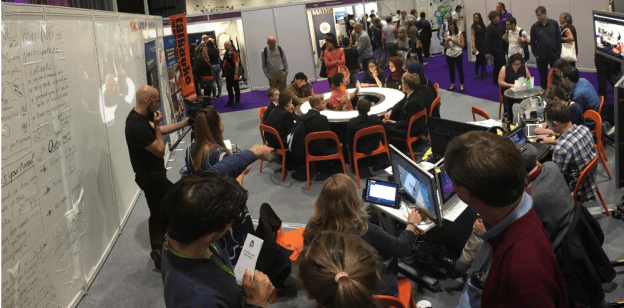
Guest blog: Saul Albert and colleagues on the “Conversational Rollercoaster” EM/CA exhibition

Conversation Analysis is hardly known as a spectator sport, yet it offers a great way to involve members of the public to see what interactional research might look like. Saul Albert organised a superb demonstration, lasting over four days, of CA analysts from Queen Mary, Loughborough, Keele, York, Oxford, and Roehampton working at a major London science exhibition. This is his report.

saul-albert-oct-2016

Saul Albert, Queen Mary University of London

New Scientist Live is one of the largest science festivals in the UK, so when they asked our Cognitive Science group at Queen Mary University to propose a hands-on public engagement activity, I challenged myself to come up with a way to ‘demo’ EM/CA.

Continue reading

Spoofing the predatory “open-access” journals

As an author, you want to put your work in a place where it will be read widely. Indeed the people funding your research (including your own University) may demand that you find a way of doing so. But not every journal promising open access to your work is quite what it seems…. Continue reading

Guest blog: Stuart Ekberg on digital psychotherapy

Can psychotherapy really be offered online, without seeing or hearing the other person? Is rapport possible? What does the therapeutic conversation look like? These are increasingly topical questions as therapists explore the affordances of the internet and email. In this fascinating guest blog, Stuart Ekberg introduces us  to the world of digital therapy in his report on the article in the new issue of ROLSI that he wrote with Alison R. G. Shaw, David S. Kessler, Alice Malpass and Rebecca K. Barnes.

stuart-ekberg-2016

Stuart Ekberg, QUT, Brisbane

Talk is supposed to be central to psychotherapy – so much so that therapy has been described as ‘the talking cure’ since the 1890s. However central, this basic format has not been immune from digital disruption. Continue reading

Guest blog: Lucas Seuren on reading classic CA

One of the pleasures of PhD work is the chance to browse in the dustier corners of the digital library. Lucas Seuren reports on finding books and articles which pack a remarkable punch, even many years after first publication.

screen-shot-2016-09-09-at-15-25-41

Lucas Seuren, Groningen University

A few years ago, before I had started as a PhD student, I attended a few talks by Trevor Benjamin who at the time had just finished his dissertation on other-initiation of repair. During these talks he would point out that while conversation analytic research has developed much over the past few decades, there was still so much we did not know about what he called the ‘boring topics’. Continue reading

Guest Blog: Lisa Mikesell on repair in conversation with dementia patients

Readers of the journal will often see Conversation Analysis applied to real-world problems, and in this guest blog, Lisa Mikesell reports on her work with patients with dementia. The full story is in her article in the current issue, and here she asks how   caregivers manage the delicate task of monitoring patients’ actions – and on occasion, correcting them when things go wrong.

Mikesell photo.png

Lisa Mikesell, Rutgers University

I often work closely with clinicians, from neurologists to psychiatrists. I take a keen interest in how communicative and social behaviors are typically measured, and what those measures end up meaning clinically and practically to both providers and patients. Continue reading

Guest blog: Andrew Carlin on the ‘Directions in Ethnomethodology and Conversation Analysis’ series

Several publishers have series devoted to interactional studies, and among them is the ever-lively collection Directions in Ethnomethodology & Conversation Analysis. Andrew Carlin has kindly agreed to give us an account of the scope and range of the series, and what the collection is trying to do.

Screen Shot 2016-08-28 at 22.07.54

Andrew Carlin

With the closure in 1994 of George Psathas’ Studies in Ethnomethodology and Conversation Analysis, there was a need for a new book series that was recognized as an outlet dedicated to high quality ethnomethodological and conversation-analytic research. Continue reading

Guest blog: The Oulu University Multi-Tasking Research Team (iTask)

I’m delighted to welcome back Antti Kamunen to report again on the exciting activities of the iTask research team, based at Oulu University (Finland). “Multi-tasking” in interaction with other people means synchronising multiple activities between participants, and is, as you can imagine, as complex as it is rewarding to analyse. Antti takes up the story.

In the previous post a few months ago, as the iTask project was just beginning, I introduced the team, the initial research questions and the method. Since then, research has shown that interactional multitasking is a pervasive phenomenon; it is everywhere and nowhere! So there is lots more to report, which I think will be of interest to ROLSI blog readers. Continue reading

Guest blog: Bethan Benwell on patients’ small talk while being assessed for surgery

Even the most sober-sided institutional interaction can be infused with ordinary human concerns, expressed in everyday terms. In this very welcome guest blog trailing her and May MacCreaddie‘s article in the new issue of ROLSI, Bethan Benwell casts a humane yet analytic eye over the talk that goes on in a highly charged medical encounter. Continue reading

Guest blog: Weatherall and Keevallik on claims about others’ mental states

Some forms of words are so completely familiar that we never notice the work they do. In this guest blog, Ann Weatherall and Leelo Keevallik make us look afresh at the formulation I [mental appreciation] that you X, where X is some state of mind – so things like I know that you’re angry, or  I thought that you’d like that and so on. Are they as innocent as they seem? Their article is in the latest issue, but to see how they got there, read on….

Screen Shot 2016-08-15 at 14.44.26.png

Ann Weatherall, Victoria University of Wellington

This paper had a long and sometimes fraught gestation. In this blog we describe how the research began, the difficulties we encountered in defining/refining our target phenomenon and the challenges of establishing the interactional matter it was mobilised to address. The research process has been a roller coaster ride of highs from the thrill of discovery to the lows of (at first!) failing to convince reviewers. It is very satisfying to have the end result finally published. Continue reading

Guest blog: Alexandra Kent and Kobin Kendrick on Imperatives

How do you get someone to do something? The range is from making a gentle hint through to barking out a peremptory order (and further on out to issuing an undisguised threat). In the latest issue of ROLSI Alexandra Kent and Kobin Kendrick tease out the subtle elements of actions done and undone in a blow-by-blow analysis of directives in interaction. Here Alexandra and Kobin recruit the British royals into an illustration of their study.

Screen Shot 2016-08-07 at 17.22.04

Alexandra Kent, Keele University

During the 2016 Trooping the Colour Parade to celebrate Queen Elizabeth II’s official birthday, the British Royal Family stood on the Buckingham Palace Balcony together to watch an aircraft fly-past by the Royal Air Force (RAF). Continue reading