Category Archives: Teaching

Guest blog: Charlotte Albury on teaching CA to clinicians

Conversation analysis is increasingly being rolled out as a method for practitioners to use in their work, or at least as a corrective to the idea that all qualitative research is simply a matter of interviewing people. If it has the effect of sensitising them to the ebb and flow of talk in their everyday practices , that’s a bonus. I’m delighted that Oxford early-career researcher Charlotte Albury has written us a blog about her experiences in putting CA in front of a group of medical practitioners.

Charlotte Albury

Charlotte Albury, Nuffield Department of Primary Care

Recently I was invited to teach Conversation Analysis at the University of Antwerp. Their qualitative research methods summer school trains clinicians, quantitative researchers, and research students in qualitative research design; analysis; and appraisal, with a focus on clinical settings. Continue reading

Guest Blog: A survey of CA craft skills

How do you handle your data? One big file? Hundreds of randomly-lableled files, in odd folders? Or a carefully curated, updated and catalogued easy-retrieval system? Sarah J White set out to find the answer from her fellow Twitter users….

Screen Shot 2018-06-14 at 09.58.29

Sarah J White, Macquarie University

A few weeks ago I started thinking about processes and tools in conversation analysis. This year I have embarked on my biggest CA project since my PhD, so I thought it was time for a refresh to ensure I am keeping up. There are many, many resources available on how to do CA (I even have a methods chapter coming out soon), but that actual processes used to document the analysis seem less well defined. Continue reading

Guest blog: Melisa Stevanovic and Elina Weiste on impossible content analysis

Two of Finland’s most active and productive young Conversation Analysis researchers, Melisa Stevanovic and Elina Weiste,  tried their hand at an intriguing experiment: analysing what people said about doing CA. The result was a thoughtful article (not in ROLSI) but clearly there was more to it than that, so I was delighted when they agreed to do a guest blog here.

The title they suggested was “On the impossibility of conducting content analysis: Back story of our data-session paper”, which sets the scene tantalisingly…

Melisa head

Dr Melisa Stevanovic, Helsinki University

Screen Shot 2018-01-06 at 16.27.10

Dr Elina Weiste, Helsinki University

Continue reading

Six ways not to do discourse analysis

A recent blog by Dariusz Galasiński about the poverty of some qualitative analysis has prompted me to dust down an old paper from back in 2003. Written mostly by Michael Billig, it was something of a succès d’estime among those who could find it – but it got lost when the online journal it was in folded. Its worries about discourse analysis are easily generalised to qualitative research more broadly; and, as Galasiński’s blog shows, still all too topical.

This is an abridged version; if you’d like to read the properly referenced full thing, probably the easiest place to get it is as a .pdf from Loughborough University’s repository.

Discourse analysis means doing analysis: A critique of six analytic shortcomings Continue reading

Loughborough’s CA Days – the 10th Anniversary

2016 was the 10th successive year we’ve held a Conversation Analysis Days at Loughborough University’s Department of Social Sciences. Here’s a brief account of how we got here, and why we think that it’s such a popular and enjoyable occasion. Charles Antaki and Liz Stokoe, organisers.

Screen Shot 2016-12-31 at 23.50.36.png

Charles Antaki

Screen Shot 2016-12-31 at 23.50.15.png

Liz Stokoe

It started out as a bright idea to invite friends and colleagues doing CA to come to a day’s meeting at Loughborough – no real reason, other than a sudden enthusiasm of the ‘let’s put a show on right here in the barn‘ type, and a list of people we wanted to see.

Continue reading

Guest blog: Saul Albert and colleagues on the “Conversational Rollercoaster” EM/CA exhibition

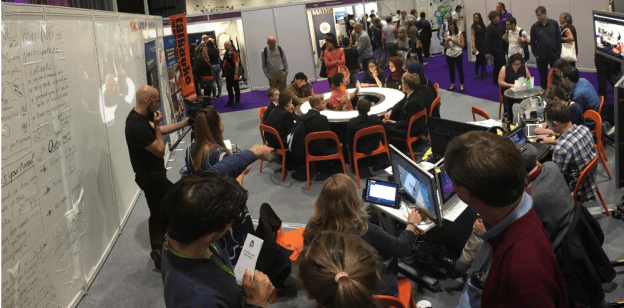
Conversation Analysis is hardly known as a spectator sport, yet it offers a great way to involve members of the public to see what interactional research might look like. Saul Albert organised a superb demonstration, lasting over four days, of CA analysts from Queen Mary, Loughborough, Keele, York, Oxford, and Roehampton working at a major London science exhibition. This is his report.

saul-albert-oct-2016

Saul Albert, Queen Mary University of London

New Scientist Live is one of the largest science festivals in the UK, so when they asked our Cognitive Science group at Queen Mary University to propose a hands-on public engagement activity, I challenged myself to come up with a way to ‘demo’ EM/CA.

Continue reading

Guest blog: Andrew Carlin on the ‘Directions in Ethnomethodology and Conversation Analysis’ series

Several publishers have series devoted to interactional studies, and among them is the ever-lively collection Directions in Ethnomethodology & Conversation Analysis. Andrew Carlin has kindly agreed to give us an account of the scope and range of the series, and what the collection is trying to do.

Screen Shot 2016-08-28 at 22.07.54

Andrew Carlin

With the closure in 1994 of George Psathas’ Studies in Ethnomethodology and Conversation Analysis, there was a need for a new book series that was recognized as an outlet dedicated to high quality ethnomethodological and conversation-analytic research. Continue reading

Entertaining video clips for teaching (5)

Jenny Mandelbaum offers these videos that she and colleagues use in teaching CA at Rutgers:

Jenny adds that YouTube has a free downloader, called YTD Video Downloader, available at http://download.cnet.com/YTD-Video-Downloader/3000-2071_4-10647340.html

Data sessions around the world

Many groups of language-in-interaction researchers have regular meetings at which they look over a recording and share their analytic insights. These data-sessions can be a very useful and productive way of generating ideas, as well as being enjoyable occasions for like-minded researchers to feel part of a community.

Over the next weeks we shall be drawing up a list of these data sessions, to have a record of them in one place.

If anyone would like to add their group to the list, do please contact us at c.antaki@lboro.ac.uk.