
One of the best and most productive ways to refresh, restore, and recalibrate scholarship is to meet with like-minded researchers. Reporting on just such a meeting, Philippe Sormani, Jakub Mlynář & Clemens Eisenmann give us an inside look into ethnomethodologists at work in the delightful surroundings of the Swiss Alps.
In 1986, Harold Garfinkel hinted at Harvey Sacks’ pioneering work on analysing the local order of conversation as the origin of “ethnomethodological studies of work” (Garfinkel 2019 [1986]: xi). Over the same decade, Garfinkel and his colleagues also articulated and positioned studies of work as an alternative programme to conversation analysis. Forty years on, the broader field of ethnomethodology and conversation analysis (EM/CA) is still marked by projected unity as much as concrete multiplicity.
“What [have] ethnomethodology and conversation analysis […] to do with each other?”
Garfinkel asked this question at an EM/CA session “Ethnomethodology: Hybrid Studies of the Workplace” at the ASA meeting in 1998, while inviting its participants, among them Rawls, Heritage, Goodwin, Lynch, and Agre, to discuss it “with a focus on materials.”
For the 2026 meeting of New Developments in Ethnomethodology (NDEM), we took our cue from Garfinkel’s question and (co-)organized an international conference under the title “Hybrid Studies: Of Work, Talk, and Technology.”
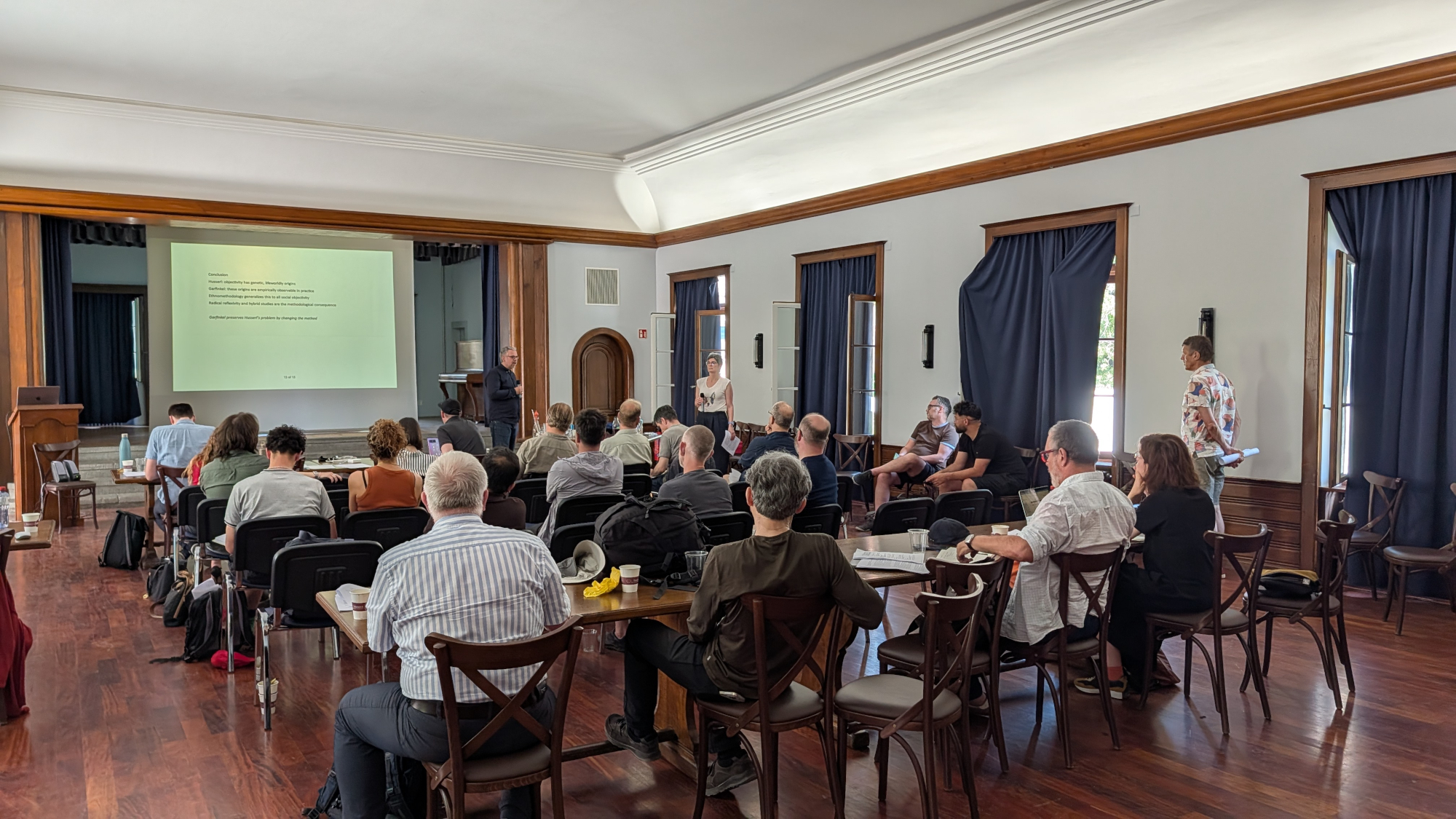
Photo by Iulia Avgustis
From 27 to 29 May 2026 the conference brought together more than forty leading practitioners of EM/CA, traveling to Switzerland from Europe (e.g., Gothenburg, Manchester, Paris) and overseas (e.g., Hong Kong, Macau, Toronto), at the HES-SO University of Applied Sciences in Sierre, a Swiss mountain town in the canton of Valais-Wallis. Twenty-six talks allowed the presenters and conference participants to discuss hybrid studies in and across EM, CA, and a wide range of settings, including mountain rescuing, precision surgery, and (we didn’t anticipate that) Antarctica expeditions. Three roundtables allowed us to engage with and discuss transversal issues, topical and methodological, as well as Garfinkel’s plans for a hybrid studies research programme in light of critique, description, phenomenology, and the materials available at the Harold Garfinkel Archive in Newburyport, Massachusetts (USA).
Irony
As organizers, we started out the conference by noting the irony between recent complaints about Garfinkel’s plea for hybrid studies (e.g., “broken promises”) and the great turnout of prospective contributors having travelled all the way to Sierre, this (relatively) remote town in the Swiss Alps. The ironic introduction, in fact, anticipated three days of joint inquiry, analysis, and argumentation. In Garfinkel’s terms, the conference afforded us with a “phenomenon that is itself a worksite” (Garfinkel 1992, in Lynch 2023: 9) – and perhaps because the conference coincided with what was to be this year’s first heatwave, the discussions were not overly heated, though there was a remarkable variety of views and approaches, uniquely adequate in their specific ways, both “hip” and hybrid!
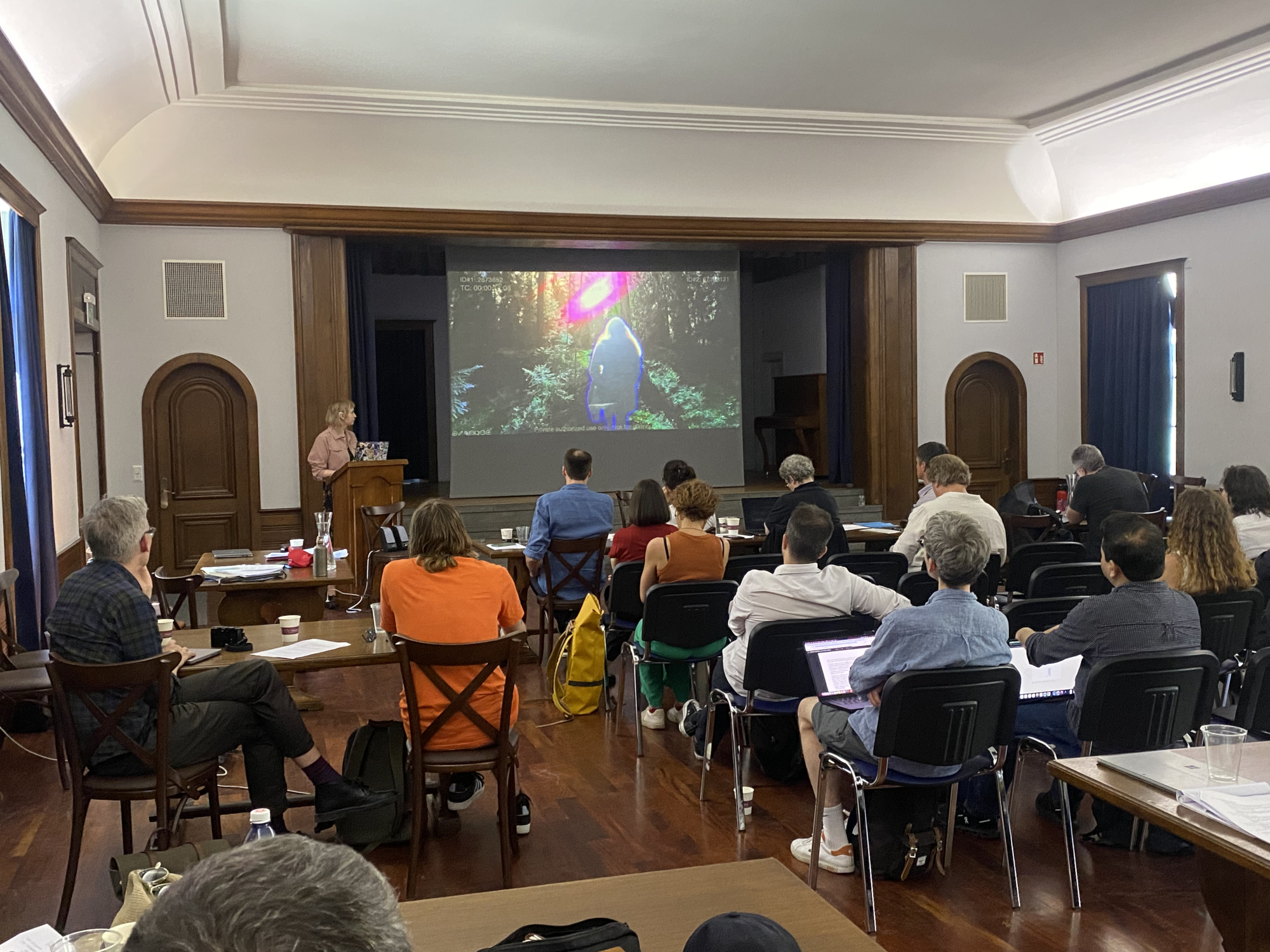
Photo by Balthazar Braganca.
As the conference subtitle suggested, the nexus of topics discussed – relating to “work, talk, and technology” – is of societal relevance, if not sociological interest, beyond EM/CA research.
Over recent years, it has become almost impossible to consult news media without landing on a commentary page, discussing the prospects and pitfalls of new information technologies, especially with respect to “artificial intelligence” and its (rhetorical) renaissance. Far from nurturing this “hype,” the common grounding of EM/CA approaches, and “hybrid studies of work” in particular, in and as the detailed explication of everyday practices – specialized, varied, and/or prosaic – allowed us to gather a stunning variety of studies, settings, and situations, ranging from museum exhibitions and forensic inquiry to robot (re-)design, chemistry experimentation, and dance performances.
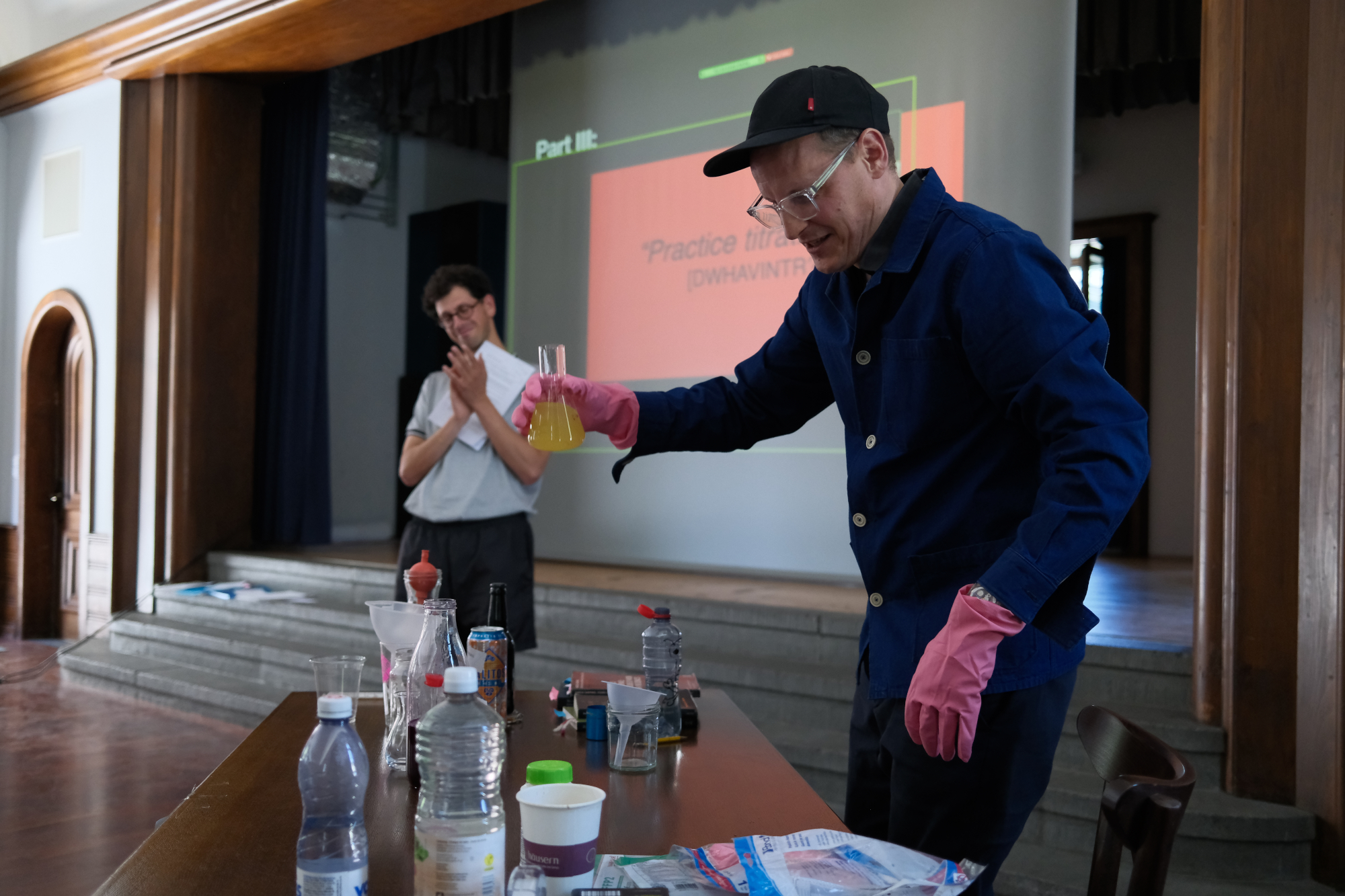
Photo by Oskar Lindwall
This common grounding reminded us – organizers, presenters, discussants – of the reflexive temporality of EM/CA inquiry, grounded in and/or to be grounded in (and out of) the very situations in which it takes place – historical, ethnographic, interactional. And the point also held with respect to the Alpine setting as a meeting place for EM/CA practitioners to share their work, established or new, and to (re-)engage in undistracted conversation on present inquiry, including past affordances and promising prospects. Various forms of practical engagement, ranging from video ethnography to technical (re-)enactment, provided heuristic resources for specifying what hybrid studies may and actually do deliver – not only as a plea, programme, or argument, but as an actual practice of inquiry, description, and reflection – to be continued, at the next NDEM meeting!
Book of abstracts: https://www.hevs.ch/media/document/23/ndem-2026-hybrid-studies-book-of-abstracts-25may.pdf
Conference description / call for papers: https://www.academia.edu/145370132/CALL_FOR_ABSTRACTS_Hybrid_Studies_Of_Work_Talk_and_Technology_New_Developments_in_Ethnomethodology_2026_27_29_May_2026
Conference website: https://www.hevs.ch/fr/events/hybrid-studies-of-work-talk-and-technology-new-developments-in-ethnomethodology-2026-214081
The event was supported by the Swiss National Science Foundation (Scientific Exchanges grant
no. 241843) and HES-SO University of Applied Sciences and Arts Western Switzerland (program PROMDOM). Organized in cooperation with “Media of Cooperation”, CRC 1187, University of Siegen.

