
The meeting between the President of the United States and the President of Ukraine in the White House on February 28, 2025 made headlines around the world. President Trump and his vice president JD Vance accused President Zelensky of obstructiveness and ingratitude, in what many saw as offensively intemperate terms. The details of the exchange bear close scrutiny and study, and we are lucky to have a detailed and thoughtful analysis by Alexa Hepburn.

Political meetings between heads of state typically follow a predictable structure: expressions of goodwill, diplomatic pleasantries, and controlled messaging. Even in disagreement, leaders maintain strategic ambiguity to uphold a sense of alignment or at least mutual respect (e.g., Biden & Zelenskyy, 2021). However, the February 28, 2025, Oval Office meeting between U.S. President Donald Trump and Ukrainian President Volodymyr Zelenskyy broke sharply from this norm. Widely described as unprecedented in its public confrontation, some media outlets framed it as an “ambush” (Nichols, 2025), with Zelenskyy “aggressively bullied” (Elser, 2025). Others portrayed a two-way dispute, calling it a “shouting match” (Sanger, 2025) or a “spat” (Faguy & Matza, 2025).
This blog applies Conversation Analysis (CA) to examine some key moments of interactional trouble, exploring whether this was an orchestrated ambush or a heated but symmetrical exchange. My complete transcript is via this link; here I’ll go through it in stages.
The meeting, and a question from a journalist
The meeting took place in the Oval Office, the U.S. president’s office, in front of journalists, in an internationally live broadcast event. Roughly 40 minutes into the meeting, a Polskie Radio journalist posed a direct challenge to Trump: “I’m talking with my friends in Poland, and they are worried that you align yourself too much with Putin. What’s your message for them?”. The question presupposes Trump’s alignment with Putin as a problem. Rather than rejecting the premise, Trump responded ambiguously: “Well, if I didn’t align myself with both of them, you’d never have a deal. […] I’m not aligned with anybody. …I’m aligned with the world.”
Vance concurs and claims that the previous US administration’s Ukraine-aligned policy simply resulted in Ukrainian losses, and that therefore “diplomacy” was now necessary. However, this claim directly contradicts Zelenskyy’s experience of past diplomatic failures. In the lead-up to the next segment, Zelenskyy had been listing instances where agreements with Putin were broken, from Crimea in 2014 to recent failed ceasefires. We now join the conversation as he challenges the President’s account.
Zelenskyy’s Challenge: What Kind of Diplomacy?
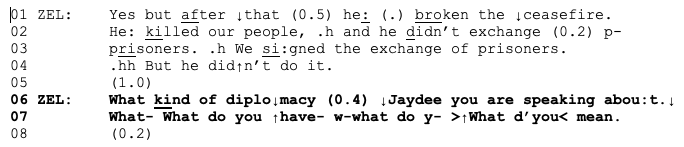
Zelenskyy’s question about “what kind of diplomacy” Vance is referring to following his listing of failed examples of diplomacy may be grammatically seeking clarification, but interactionally functions as a challenge, indexing skepticism about its effectiveness with Putin. This positions Vance’s prior claim about diplomacy as potentially inadequate, needing further explanation.
Vance’s Response: From Diplomacy to Discipline
An appropriate response for Vance might be to acknowledge the difficulty of the diplomatic task ahead and respond with examples of what might work (e.g., negotiations with Putin, peace deals, territorial concessions) or make suggestions for moving the discussion to the private meeting, as would be the norm. Instead, he replies with a nonspecific outcome-oriented claim about “the kind of diplomacy that’s gonna end the destruction of your countr[y.” (lines 9-10). This shifts attention away from past diplomatic failures, positioning Vance as the authoritative voice about Ukraine’s future.
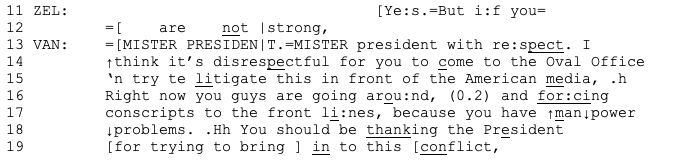
Zelenskyy begins to respond with ‘but if you are not strong’ (lines 11-12) likely indexing his prior hope that the US will provide security guarantees (weapons, intelligence) if Putin does not comply with the proposed ceasefire. However, Vance interrupts Zelenskyy with a rebuke:
A significant move
Vance’s move here is significant. Rather than continuing to defend diplomacy as a principle or noting that this will be ironed out in later discussions, he explicitly admonishes Zelenskyy, asserting that it is “disrespectful” to “litigate this in front of the American media” (line 15). This shifts the nature of the discussion away from Zelenskyy’s doubt about the effectiveness of diplomacy to a meta-level claim about the way he’s making it, effectively disciplining his challenge rather than responding to it.
Following this, Vance abruptly switches to an accusation – that Zelenskyy is ‘forcing conscripts to the front lines’ (lines 16-18) due to ‘manpower problems’. He concludes with the moral imperative: ‘You should be thanking the President…’ (line 18), a line which has since resonated around the world..
Vance’s strongly critical interruption is in ironic contrast with his prior turn espousing diplomacy as ‘the path to peace’. By making relevant some response from Vance about the ineffectiveness of past diplomacy, Zelenskyy is accused of a) a lack of respect, b) inappropriately litigating past failures of diplomacy, c) forcing his own conscripts to the front line, and d) a lack of gratitude.
This shift from debating policy to making accusations and policing Zelenskyy’s contributions is strategy that will continue in the following segments.
Zelenskyy’s defence
Zelenskyy pushes back against Vance’s claims about Ukraine’s problems with a counterchallenge, questioning the epistemic basis for them:

Rather than engaging with the accusation of “disrespect,” Zelenskyy returns to the topic of war and diplomacy. His negatively polarized question on line 20 projects a ‘no’ response, conveying an expectation that Vance has not visited Ukraine (something he clearly knows). If Vance confirms he hasn’t visited, his claims lose credibility. Amidst Vance’s faltering response (line 23), Zelenskyy’s issues an invitation to visit, offering Vance a way out – he could accept it diplomatically and move on. Instead, Vance defends his claims by citing unspecified media sources:
Vance’s “Stories” and the “Propaganda Tour” Accusation

Here Vance claims to have “watched and seen” reports about Ukraine. This functions as a counter to Zelenskyy’s premise that direct experience is necessary. However, he doesn’t specify sources, leaving him open to requests for clarification. Zelenskyy’s head shake and possible sotto voce Russian expletive display subtle rejection of Vance’s assertion. Vance then escalates by accusing Zelenskyy of taking visitors on a “propaganda tour” suggesting that Zelenskyy’s presentations of the situation in Ukraine were misleading or staged, and providing support for his own media-based epistemic access. This is a dramatic escalation that reframes Zelenskyy’s diplomacy not just as ineffective, but as actively deceptive.
Vance’s Questions
Having escalated his prior attack on Zelenskyy’s credibility, Vance now shifts to a strategy of accusatory questioning. This move is significant because, rather than providing evidence for his claim about “propaganda tours,” Vance instead reorients the discussion by issuing a series of polar questions:
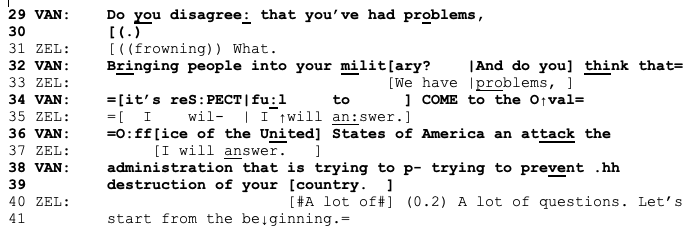
These polar questions limit Zelenskyy’s options – agreement is the structurally preferred response (Sacks, 1984). The first question “Do you disagree that you’ve had problems?” (line 29) functions as an invitation to concede that Ukraine is struggling. But the second question: “And do you think it’s respectful to come to the Oval Office and attack the administration?” packages an accusation as a question – agreeing would mean conceding to the charge of disrespect; disagreeing risks escalating the dispute.
These questions also embody the presumption that Vance can determine a) what is going on in Ukraine, and b) what counts as ‘respectful’. Instead of engaging in discussions, Vance treats Zelenskyy as needing to be put in his place – his stance is not simply argumentative, but disciplinary. This makes his actions seem browbeating rather than just disagreement.
Zelenskyy’s Resistance: “A Lot of Questions”
Instead of engaging with any one accusation directly, Zelenskyy treats Vance’s questioning as a category of action – a barrage rather than a constructive inquiry. This sidesteps the trap of direct agreement/disagreement by addressing the format rather than the content of the questions, implicitly critiquing the legitimacy of the questions, suggesting that they are not an attempt at dialogue but an overwhelming interrogation.
Trump’s rejection: ‘You don’t know that’
Zelenskyy begins his response to Vance by noting that everyone has problems when they are at war, producing it as a shared human condition rather than something he has caused, or a uniquely Ukrainian problem. He predicts that even the US will ‘feel’ or experience the effects of war despite the ‘nice ocean’ between them and Russia, at which point Trump enters:
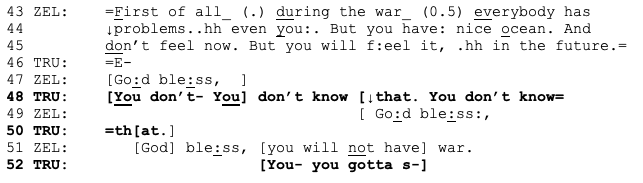
Zelenskyy’s ‘you will f:eel it, .hh in the future’ (line 45) can be heard as seeking to establish common ground by suggesting that the war will have consequences for the U.S. as well. As such it provides something of a warning about Putin’s possible future aggression, suggesting that distance alone will not shield the U.S. from war’s effects. At this point Trump cuts in with a direct epistemic challenge: ‘you don’t know that’ (line 48). Meanwhile Zelenskyy continues in overlap with various attempts to mitigate the predictive element of his turn: ‘[God] ble:ss, [you will not have] war.’ reframing it as a wish rather than a warning, while perhaps also indexing his own epistemic access to what being in a war involves.
It’s important to note here that Zelenskyy does not actually “tell” the U.S. what it will feel—instead, he first makes a factual claim (“Everybody has problems during war”), then shifts to a forecast (“You will feel it”), and finally mitigates this with “God bless, you will not have war.”
However, Trump does not allow this mitigation to shift the trajectory—instead, he escalates his rejection further.
‘Don’t tell us what we’re gonna feel’
Trump transforms his epistemic rejection into a directive: ‘Don’t tell us what we’re gonna feel’. This shifts from an epistemic dispute (“You don’t know that”) to an outright prohibition. We know that directives embody strong entitlement to direct the activities of the recipient. Here Trump frames Zelenskyy’s prior utterance as illegitimate, prohibiting Zelenskyy from making claims about American experience, and moves the interaction from an argument over war’s consequences to one over participation rights.
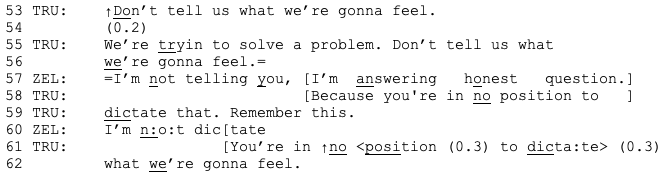
Zelenskyy counters with a claim about the activity that he was building towards ‘I’m not telling you, I’m answering honest question’, reframing his prior talk not as an assertion, but as a response. By doing so, he pushes back against the characterization that he is overstepping his role.
Rather than engaging with Zelenskyy’s attempt to smooth things over, Trump continues with ‘You’re in no position to dictate”, treating Zelenskyy as overstepping his epistemic rights and inappropriately dictating to him. Trump again ignores Zelenskyy’s attempt to counter this on line 60, instead repeating the prohibition more emphatically. Rather than debating the claim that the U.S. will eventually feel the impact of war, Trump shifts the focus onto who has the right to discuss it. It also acts as a kind of rebuke, positioning Zelenskyy’s actions as inappropriate and indexing his inferior ‘position’ relative to the US.
It’s worth contemplating Trump’s turns here: “Don’t tell us what we’re gonna feel” and “You’re in no position to dictate” seems disproportionately aggressive given that Zelenskyy’s turn builds common ground by suggesting that the war will have consequences for the U.S., as well as working hard to reiterate mitigation of this statement in the clear.
If Trump’s concern was diplomacy and factual accuracy, he could have simply disagreed (e.g. “that’s not how I see it’) rather than issuing a directive prohibiting Zelenskyy from making the claim at all. He could also have responded to “God bless, you will not have war” (e.g., “I certainly hope not”). Instead, he chooses to keep the conflict alive by insisting on policing Zelenskyy’s participation. This suggests that Trump may not have been responding to Zelenskyy’s claim in real time, rather he was looking for an interactional opening to discipline his participation, and his choice of focus on Zelenskyy’s “telling” the U.S. what it will feel may have been opportunistic. It was certainly not attentive to the activity that Zelenskyy was building.
Trump continues repeating his prior turns, while Zelenskyy attempts to continue responding to the question:
‘You’ve allow:ed yourself to be in a ve↑ry bad position.’
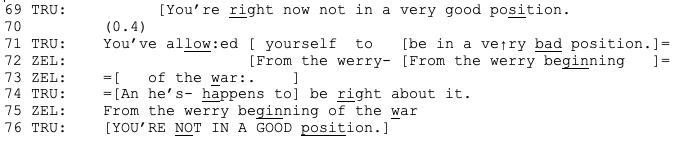
Two interesting things about Trump’s continuation here are that firstly, he claims Zelenskyy has ‘allowed himself’ to be in a ‘very bad position’. This treats Zelenskyy himself, rather than just Russia, as responsible for his country’s weakness. While Zelenskyy’s turns are occupied with detailing Russian aggression and Ukrainian resistance, Trump’s turn here focuses on Zelenskyy’s decisions as President, raising the possibility that Ukraine doesn’t deserve more support.
A second interesting thing here is Trump’s repair: ‘He’s- happens to be right about it’. In this turn he indicates his agreement with Vance, presumably related to Ukraine’s ‘manpower’ problems. But why the repair from ‘is’ to ‘happens to be’? One candidate is that if Trump had said “He’s right”, it might suggest Vance is leading the charge, with Trump simply backing him. By adding “happens to be”, Trump distances himself just enough to avoid making it look like Vance and he are acting as a team to ambush Zelenskyy. So the repair allows him to signal agreement with Vance, but in a way that suggests an organic alignment rather than a pre-planned attack.This turn also makes it harder for Zelenskyy to push back against the combined force of Vance and Trump.
In any event, by controlling the operation of turn taking, aggressively policing any undermining of his epistemic authority, and blocking future challenges rather than engaging with the substance of Zelenskyy’s talk, Trump works to shut down Zelenskyy’s further building of Ukraine as victims of Russian aggression.
Having successfully constrained Zelenskyy’s participation, Trump launches his final and most serious accusation:
‘You’re gambling with World War three’
By building Ukraine’s resistance as ‘playing cards’ and ‘gambling’ (lines 78-86) Trump constructs Zelenskyy as reckless, as if he’s treating war like a game. Zelenskyy resists this metaphor, but Trump evades his attempt to refute this, repeating “You’re playing cards. You’re gambling.” By repeating the description even after rejection, Trump forces it onto Zelenskyy, controlling the terms of debate.
Trump then escalates his accusations shouting that Zelenskyy is gambling with “World War Three”:
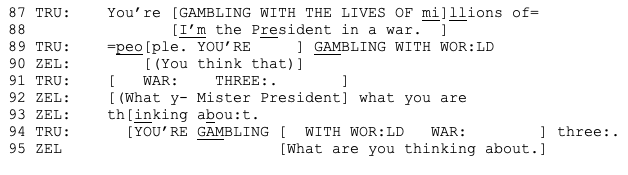
Not only is Zelenskyy risking Ukrainian lives, but he is also endangering global stability. Zelenskyy attempts to resist the accusation by shifting the burden of explanation back onto Trump, repeating in overlap (‘What are you thinking about.’ Lines 92, 93 and 95). However, Trump pushes through the overlap, repeating his charge with increased volume, again shutting down Zelenskyy’s interaction rather than engaging with his contributions. Trump’s repeated insistence that he is gambling removes legitimacy from Zelenskyy’s diplomatic requests. If Zelenskyy is positioned as a reckless gambler, then his appeals for support can be dismissed as irresponsible escalation rather than strategic necessity.
Rather than being able to argue for Ukraine’s needs, Zelenskyy now has to justify his own respectfulness, seriousness, gratitude, and decision-making.
Conclusion – Ambush or Heated Exchange?
It’s clear that this exchange amounts to more than a two-way argument. Throughout the meeting, Trump and Vance do not simply challenge Zelenskyy’s claims – they constrain his participation. They interrupt, redirect, assert, accuse, criticize, rebuke, and continue in overlap to limit Zelenskyy’s ability to build his case. While some media characterized it as a “heated exchange” or “shouting match,” digging deeper into the interaction suggests that Trump and Vance were not engaging on an equal footing with Zelenskyy so much as disciplining his participation. Despite advocating for diplomacy as the path to peace, both Trump and Vance abandoned its principles in their treatment of Zelenskyy. Instead of engaging in respectful dialogue or addressing Zelenskyy’s concerns about diplomacy’s ineffectiveness with Russia, they relied on tactics that silenced Zelenskyy’s advocacy and positioned him as subordinate.
Was it an ambush? While there is evidence that both Trump and Vance were looking for interactional opportunities to belittle and discipline Zelenskyy, it’s impossible to say how pre-planned (as opposed to opportunistic) this apparent entrapment was. Zelenskyy was certainly the victim of a coordinated, asymmetrical, and at times personal, attack.
References
Biden, J., & Zelenskyy, V. (2021, August 31). Remarks by President Biden and President Zelenskyy of Ukraine before bilateral meeting. The White House. https://www.rev.com/transcripts/joe-biden-ukraine-president-volodymyr-zelensky-bilateral-meeting-transcript
Elser, D. (2025, March 7). Trump’s sickening Ukraine game exposed. news.com.au. https://www.news.com.au/world/north-america/us-politics/be-very-very-afraid-donald-trump-accidentally-reveals-his-ukraine-plan-during-zelensky-clash/news-story/13c67be9d3c7c09eadf29077e23eaeca
Faguy, A., & Matza, M. (2025, February 28). Donald Trump accuses Zelensky of ‘gambling with World War Three’. BBC News. https://www.bbc.com/news/articles/cvg17jmm5vxo
Nichols, T. (2025, February 28). It was an ambush. The Atlantic. https://www.theatlantic.com/ideas/archive/2025/02/ukraine-us-relations-trump/681880/
Sanger, D. E. (2025, March 1). Behind the collision: Trump jettisons Ukraine on his way to a larger goal. The New York Times.
 Research on Language and Social Interaction - Blog