
Erving Goffman’s legacy is everywhere visible in the social sciences, and Wendy Leeds-Hurwitz‘s new book shines light on the “invisible college” of his contemporaries among his close circle and further afield. The result is a fascinating account of the intellectual climate of the 1960s-1980s, and a throughly engaging read for all whose work has felt the influence of Goffman down the ages.

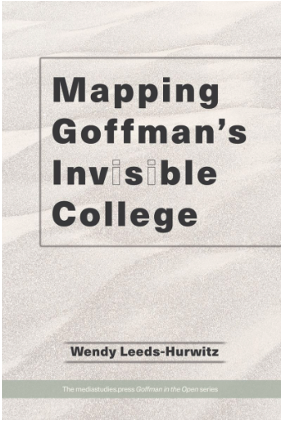
In writing Mapping Goffman’s Invisible College (Leeds-Hurwitz, 2025), I followed the advice I was given in graduate school: to research something most others did not know about. The name, and the work, of Erving Goffman are of course well known in the social sciences; but he has typically been described as a “loner” and I wanted to throw some light on the intellectual environment surrounding him.
Here I will describe two elements: why I began this project in the first place, and a little about the research process.
Origin Story
I was invited to present as part of a celebrationin Brazil in 2022 honoring the 100th anniversary of Erving Goffman’s birth. I thought about what I knew that neither I nor others had already written about, given that an enormous literature discussing Goffman and his ideas already exists (full disclosure: I co-authored one of the books: Winkin & Leeds-Hurwitz, 2013, and wrote chapters for two others prepared in honor of the same anniversary: Lenz & Hettlage, 2022; Jacobsen & Smith, 2022).
Eventually I realized that as a doctoral student at the University of Pennsylvania in the 1970s, I had been research assistant at the Center for Urban Ethnography (CUE) while Goffman was there, and so I knew more about his role with CUE than most others. While writing that up, I realized there were in fact several other projects I knew something about which also had not yet been widely discussed, and added those in. I contacted the Penn archives with questions, and they were very helpful. Each project added more names of people who were part of Goffman’s invisible college. (Briefly, an invisible college describes a scholar’s connections to people who are not generally known to be part of their network.)
At least some members of his core group of colleagues at Penn should be familiar to most ROLSI readers: Dell Hymes, Bill Labov, Ray Birdwhistell, John Szwed, and Sol Worth. They were all involved in at least some of the major projects described in detail as successful, as well as at least some of the other projects covered in less detail, most of which were far less successful. The goal was not to stop after introducing the initial narrow cast of characters, but rather to demonstrate the range of people who were part of his extended network at Penn, and then beyond Penn.
My contribution to the 2022 celebration in Brazil has since been translated and published in Portuguese (in Martins & Gastaldo, 2024), but I wanted to publish in English as well. So, I visited both Penn’s archive and the American Philosophical Society (APS) archive in Philadelphia to get answers to additional questions arising as I expanded the scope of the story. (It was a pleasure to return to the APS since I had conducted some of my dissertation research there in the 1970s.) As the number of projects included in the story increased, so did my understanding of Goffman’s network, expanding not only across many departments and colleges at Penn but also to other universities (Chicago, Berkeley, Harvard, Indiana, Texas) and the National Institute of Mental Health. In the process, what was originally intended as an article grew into a book.
Research process: solving the jigsaw puzzle
Overall, this research was a complex jigsaw puzzle: 21 collections deposited in a dozen different archives each revealed different parts of the story; my task was to fit all the pieces together into a coherent story. Basically, I wrote up each project separately, and every time I located more information, I updated the relevant document. What was most surprising was just how often a folder related to one topic contained new information about another – a person who was involved who I had not yet known about, or a result that I had not yet seen documented elsewhere.
For example, a conference on the Comparative Ethnographic Analysis of Patterns of Speech in the United States, held in 1975 at Temple University, was funded by the Committee on Sociolinguistics of the Social Science Research Council (SSRC), and organized primarily by Joel Sherzer (a student of Hymes). Most of the relevant documentation was found in the Hymes Papers at the American Philosophical Society, but some was in various correspondence files (especially with Sherzer, Labov, and Allen Grimshaw) while much of the rest was located in several Committee files. The best surprise was finding the report of the event, prepared by Virginia Hymes as Rapporteur, which included detailed quotes, some from Goffman.
All archives outside of Philadelphia were contacted through email. (There are very good guides now available online revealing what information can be found in what archive, something that did not exist when I first conducted archival research for my dissertation.) I did not visit any of the other archives in person. Instead, once I had sorted out what I needed from each, the archivists could locate that documentation, copy it, and email it to me (usually for a fee). Since this research overlapped with years we were all being extra cautious due to COVID, that was important – in fact, some of the archives were still closed to in-person visits, but most of the archivists were able to be access their own records.
In the end, the vast majority of what is reported in this book was found in archives, and has not been previously reported. To give just one example, this time taken from the Allen Grimshaw papers (he was a sociologist at Indiana University who Goffman – as well as Hymes – corresponded with over decades). As a member of the Committee on Sociolinguistics at SSRC, Grimshaw organized the Multiple Analysis Project (MAP) as a way to compare different methods early in the development of sociolinguistics, and Goffman was one of the original members of MAP. This is one of the projects that failed, but we have much to learn from it nonetheless. One (of many) interesting things to know is that Goffman, even after leaving the group as a result of disagreements in terms of data collection (taking with him what Grimshaw referred to as his “constituency,” that is, Harvey Sacks and Emanuel Schegloff, who were also part of the project, but only so long as Goffman was), still visited Grimshaw at Indiana as previously scheduled a few months later, writing that he would never think “that such business could strike deep enough to wither affection.”
Professional quarrel Overall, it astonished me that such a short time after Goffman left MAP, taking Sacks and Schegloff with him, causing complications for Grimshaw and everyone else involved with that project from that point forward, he and Grimshaw were able to put history behind them to first organize all the details, and then actually manage a visit lasting several days, especially given that Goffman stayed in Grimshaw’s home. Perhaps people were simply more polite and considerate in the 1970s, but it seems unlikely that such behavior could be expected today of colleagues who had quarreled professionally to the point of leaving a joint project. It demonstrates an impressive ability to separate the personal from the professional, on the part of both Goffman and Grimshaw. They were personal friends who professionally disagreed.
I did conduct a few interviews when I needed answers I could not locate either in publications or archives – as when I contacted Robert Kleck to ask about a conference he organized with Goffman in 1969. I had seen what turned out to be an incorrect conference title and the wrong year listed in an early CV for Adam Kendon, which he sent to Allen Grimshaw in the 1970s, and which Grimshaw had deposited with his papers in an archive, where I found it. As Adam died in 2022, I was unable to simply write him and ask for details. Instead, in the process of trying to learn more about that conference, I somehow found my way to Kleck. He was gracious enough to reply and sort things out. A good example of the twists and turns of historical research.
In conclusion, what are the major things I learned putting this book together? To give only one example of what I learned about Goffman, I discovered much about his connection to sociolinguistics, hardly the topic with which he is usually associated. More generally, I learned a great deal about multidisciplinarity and interdisciplinarity and the differences between them; about invisible colleges, and the ways in which ideas need to be shared if they are to have influence; and about learning from failure (so as to be more successful in future). There is much more for me (and presumably others) to still learn about all of these general topics, though I do assume I at least have now finished writing books about Goffman.
References
Jacobsen, M. H., & Smith, G. (Eds.). (2022). The Routledge international handbook of Goffman studies. Abingdon, UK: Routledge.
Leeds-Hurwitz, W. (2025). Mapping Goffman’s invisible college. Bethlehem, PA: mediastudies.press.
Lenz, K., & Hettlage, R. (Eds.). (2022). Goffman handbuch: Leben – werk – wirkung. Stuttgart, Germany: J. B. Metzler.
Martins, C. B., & Gastaldo, E. (Eds.). (2024). Erving Goffman 100 anos: Explorando a ordem da interação. Rio de Janiero, Brazil: Ateliê das Humanidades.
Winkin, Y., & Leeds-Hurwitz, W. (2013). Erving Goffman: A critical introduction to media and communication theory. New York: Peter Lang.
 Research on Language and Social Interaction - Blog