
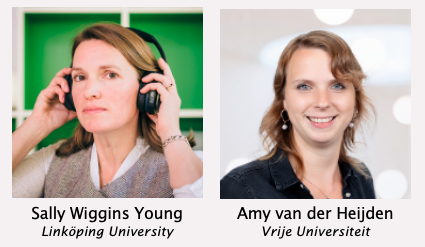
What does it mean to eat together with other people? Sally Wiggins Young has delved deep into it, and come back with a fresh, new way of seeing what had seemed to be a familiar landscape. Here she and Amy van der Heijden report on their inauguration of EatSiN, a wide-ranging group bringing together EM/CA researchers working on what happens when people eat in the company of others.
What do we know about eating as a social phenomenon? It’s been an object of study for EMCA and language socialisation research, whether as data source (such as the data set affectionately known to CA old hands as the chicken dinner transcripts), as topic (such as the latest multimodal research on tasting), or both. But there isn’t an over-arching way of thinking about it – until you stand back and compare it with other ways in which people spend time together.
What then comes out very clearly from interactional research on eating is that there is something unique about this area of research. There’s something about people sitting down together – families around a dinner table, a vulnerable person being fed by a medical aide, colleagues in a staff room sharing a coffee and a cinnamon cake – that is just different from other things they might do together.
They’re not chatting, they’re not doing business talk, they’re not exchanging news or gossip: they’re sharing sensory experiences which have all sorts of ramifications about assessment, evaluation and credit (or blame), which require some degree of synchronisation and cooperation; and it all comes bound within unspoken but carefully policed boundaries of the acceptable and the unacceptable. So, as a field of research, eating offers insights into how society regulates itself in the most familiar of contexts. To adapt a well-know Conversation Analysis slogan: interaction shapes eating and eating shapes interaction. As a topic, it deserves to be, if you will, the main course and not the side dish.
EatSiN: a network for researchers
In this blog post, we report on a new research network – EatSiN– specifically focused on research on eating in social interaction, that aims to put eating back in the centre of the analytical table[1].
Sensing our way into the network As active researchers in this area, we decided it was time to bring together some colleagues in the field to generate ideas and help kick-start the network. With research initiation funding provided by Riksbankens Jubileumsfond, we were able to host a workshop at Linköping University for a small but crucial group of researchers who are, or have been, working in this area. It was thus, as the cherry blossom bloomed in Norrköping in late April, that a small group of EMCA researchers gathered for two days to chew over the possibilities and potentialities of a network focused on eating interactions research.
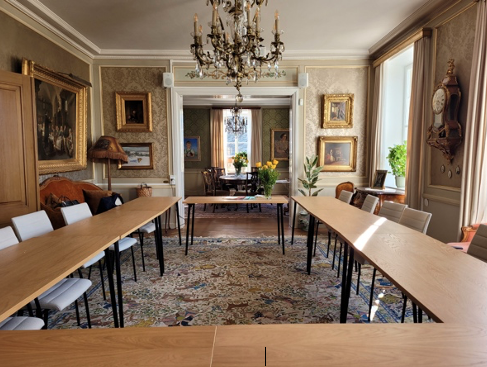
As if the cherry blossom and blue skies were not enough to enrich our senses, we also had the privilege of having the full use of a stately home, donated to the university, and perfect for such events. Complete with slippers to protect the antique rugs (following the no-shoes-indoors ethos in Sweden), it provided the richly decorated yet quiet, reflective ambience needed to consider what would be possible if we bring eating to the centre of interactional research. With a steady supply of coffee, fika breaks, and lunches, and the enviable comforts of the house, we had everything we needed to do some blue-sky thinking.
Eating for all ages and places
It was not all cake[2] and home comforts, though.
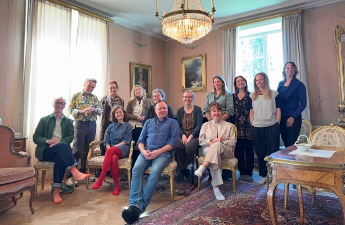
Throughout the two days we fed our minds with data sessions, presentations, and discussions on everything from what to name the network to what its aims might be. One thing was clear, however, in that despite being a reasonably small group (14 of us present), our work spanned eating across the lifespan and involving a range of interactional contexts.
We saw examples from breastfeeding infants with Amanda Bateman (Birmingham City University) preschool lunches with Jakob Cromdal, Annerose Willemsen, and Sally Wiggins Young (Linköping University) family mealtimes with Amy van der Heijden (Vrije Universiteit), Vittoria Colla (University of Bologna), Jonathan Potter and Alexa Hepburn (both Rutgers University), restaurant diners with Lorenza Mondada (University of Basel), a cookery workshop with immigrant women with Hanna Svensson (University of Gothenburg), and assisted eating in late-stage dementia with Ali Reza Majlesi (Karolinska Institute). Eating isn’t just one thing, and it doesn’t just happen around the family table: it fits into, and helps define, a range of human interactions in social spaces and institutional structures.
The two days of workshop provided all the benefits of cumulative discussions and data analyses: we began to observe recurring patterns across the various data corpora, such as how mealtimes might be brought to a close or what happens when eating never begins in the first place.
A network within and for interaction
Our appetites whetted, there were some big questions to consider. What, and who, would the network be for? While many of us are situated within interactional research, there is a much bigger world of eating research with which we could also engage; how much should we focus on developing interdisciplinary connections? Does eating need to take place in our data for the research to be included in the network’s focus? As seen in much of our data sessions, sometimes food was present but not eating became the analytical focus (such as when someone turned down an offer of food). Similarly, in the breastfeeding data, the babies were consuming fluids and therefore technically drinking; might the network also consider drinking alongside eating?
These and many other questions became our sustenance throughout the workshop. In these early days, the aim is to create a space for EMCA and related research on eating and social interaction without constraining it with an exact recipe. We want it to evolve in such a way that it meets the needs of its members, as it grows over time, and as more people join. If you’re doing interactional research (and ROLSI’s definition of language as it is used in interaction is the perfect description) and you’re interested in what happens when people eat in the presence of others, then EatSiN might be for you.
Time to digest
Setting up a network doesn’t happen overnight. Like a good meal, it is worth taking time to chew things over and digest them properly.
We follow the lead of many other successful networks and begin with some periodic online meetings in which we can meet, get to know each other, find connections, hold data sessions, have focused discussions, and see what collaborations or shared interests might emerge. We’re keen for early career researchers as well as more established scholars to join the network, and it doesn’t matter whether you are obsessed with eating research or enjoy it occasionally. EatSiN can be a feast or a welcome snack, but we hope it will nourish and give energy, nonetheless.
The remainder of our Riksbankens Jubileumsfond funding will be used to host a small inaugural conference at the Vrije Universiteit (VU) in Amsterdam in March 2026. If you’re interested in joining the network or attending the conference, email one of us (sally.wiggins.young@liu.se or a.vander.heijden2@vu.nl) and we’ll add your name to our mailing list to keep you up to date and to find out about the online meetings.
We do hope that you will join us.
For two recent examples of Sally and Amy’s work on eating, see:
Wiggins, S. (2025). Sticky Categories, Discursive Practices, and the Potential for Change: The Case of Children’s Food “Likes”. Journal of Language and Social Psychology, 44(3-4), 319-342.
Van der Heijden, A., & Wiggins, S. (2025). Interaction as the foundation for eating practices in shared mealtimes. Appetite, 205, 107585.
[1] We make no apologies for these puns.
[2] There might have been a few. For research purposes, of course.
 Research on Language and Social Interaction - Blog